Last year's P&L says your firm earned $410,000. The tax return says $468,000. When a partner asks where the other $58,000 came from, nobody in the room can answer in a sentence.
That gap is normal. Book income shows how your firm performed, and taxable income is the figure the tax code says you owe on. The two follow different rules on purpose. In a business that sells time and expertise rather than inventory, they also drift apart in ways you can see coming.
Good accounting for professional services firms keeps both numbers in view and explains the space between them. Consultancies, agencies, law practices, and architecture studios bill against hours, carry unbilled work, and get paid on the client's schedule, and every one of those habits pulls book and tax a little further apart.
TL;DR Quick Answers
Accounting for Professional Services Firms
Accounting for professional services firms treats time and expertise as the product, so it goes past clean books to show where margin, cash, and taxable income actually come from. In our experience, the firms with the fewest surprises keep their book-to-tax picture current every month.
Revenue: Track realization, unbilled WIP, and receivables, since cash-basis tax counts income only when you collect it.
Expenses: Give client meals, entertainment, penalties, and the owner draws their own accounts so your CPA can find every tax adjustment.
Assets: Keep book, federal, and California depreciation schedules side by side.
Owner pay: Record draws, distributions, and guaranteed payments separately, because only some of them are deductible.
Close: Update a book-to-tax bridge at every month-end close and hand your CPA a reconciled package.
That routine gives partners a clear view of profit, cash, and their likely tax bill months before filing season.
Top Takeaways
Book income measures how your professional services firm performed, while taxable income is what the tax code says you owe on, and the two follow different rules by design.
Most of the gap in a service firm comes from cash-basis treatment of receivables and WIP, faster tax depreciation, limited deductions for meals and entertainment, and how your firm classifies owner pay.
Temporary differences reverse in later years. Permanent differences such as entertainment and penalties change your tax bill for good.
California firms need a separate state depreciation schedule because the state skips federal bonus depreciation and caps Section 179 at $25,000.
When you update a book-to-tax bridge at every month-end close, tax season turns from a surprise into a forecast.
What Book Income and Taxable Income Actually Measure
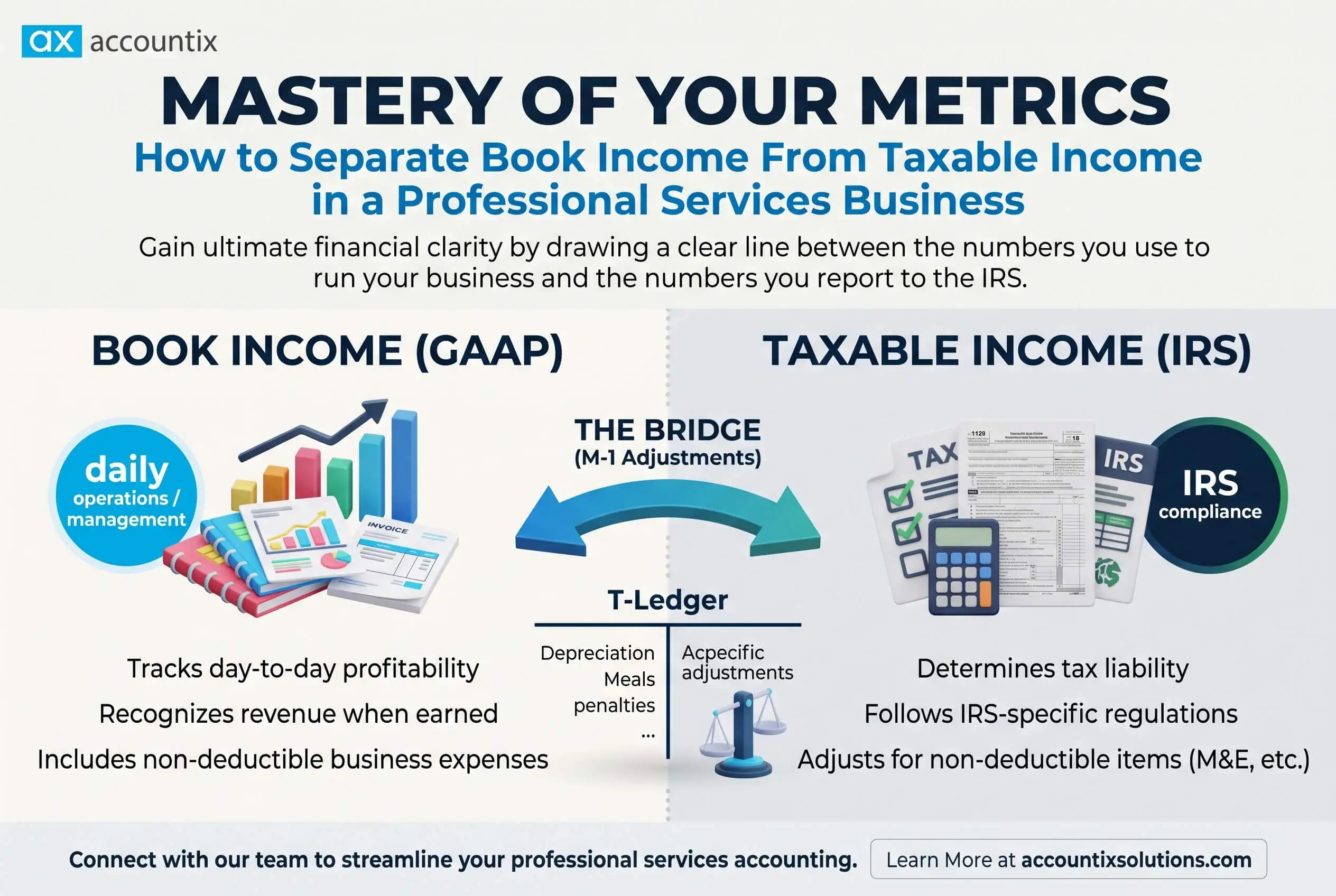
Book income is the net income in your firm's own financial records. Your team produces it through day-to-day bookkeeping under whatever method you run the business on, which for most service firms means accrual. Taxable income starts from that same number. The tax law then adds some items back and takes others out.
Your books tell you how the year went, while the return reflects what the law says you earned. You need both. Most of the trouble starts when someone treats one as the other.
Why the Two Numbers Drift Apart in Professional Services Firms
In a service firm, most of the gap traces back to five sources: when revenue counts, how you write off equipment, which expenses the tax code limits, how owners get paid, and where you file.
Accrual Books, Cash-Basis Tax
Plenty of firms keep accrual books to track realization and unbilled WIP, then file on the cash method. The IRS allows it. According to IRS Publication 538, a qualified personal service corporation in consulting, law, accounting, architecture, or engineering can generally use the cash method no matter its size. NATP notes that other firms qualify if their average gross receipts over the prior three years stay at or under $32 million for 2026.
In practice, work you bill in December and collect in January lands in this year's book income and next year's taxable income. Every swing in receivables moves the gap. And when the P&L looks healthy but the bank balance doesn't, this look at whether a fractional CFO can fix cash flow problems in a profitable business covers the cash side of the same problem.
Retainers and Advance Payments
Your books carry an unearned retainer as a liability until your team does the work. The IRS generally counts advance payments as income when you receive them, although accrual-method taxpayers can elect to defer part of a payment by one year at most. Cash-method filers count it the day it lands. Ask your preparer which treatment your firm uses, then mirror it in your bridge schedule.
Laptops, Furniture, and Office Build-Outs
In the books, you spread a $3,000 workstation's cost over its useful life. Federal tax is far more generous. IRS Publication 946 confirms that qualified property you acquire and place in service after January 19, 2025 is eligible for 100% bonus depreciation, and it sets the 2026 Section 179 limit at $2,560,000. The tax deduction hits now. The book expense trickles in over several years.
California adds a third column. The state doesn't follow federal bonus depreciation, and it caps Section 179 at $25,000, as KDA's California depreciation guide lays out. For a Los Angeles firm, one laptop can carry three different depreciation numbers.
Client Meals, Entertainment, and Penalties
Your P&L records every client lunch, conference happy hour, and late-filing penalty at full cost. The tax code is stingier. Business meals are generally 50% deductible, entertainment isn't deductible at all, and fines or penalties paid to a government never are. Deloitte's income tax roadmap lists these among the classic permanent differences.
Owner Pay, Draws, and Guaranteed Payments
Partner draws and shareholder distributions don't count as expenses on either set of numbers. Guaranteed payments to partners, on the other hand, are deductible to the partnership. Lump all of them into one "owner compensation" account and your books stop matching the return, and nobody tends to notice until the CPA asks.
Permanent vs Temporary Differences
A temporary difference reverses in a later year, while a permanent one never does. Once you sort each item into the right bucket, you'll know whether you're looking at a timing question or a real change in what you owe.
Receivables and unbilled WIP, cash-basis filers: Temporary. Your books count revenue when you earn it, and tax counts it when you collect.
Equipment and leasehold improvements: Temporary. Your books spread the cost over its useful life, while tax allows bonus depreciation or Section 179 up front.
Bad debt reserve: Temporary. Your books estimate and expense it. Accrual filers deduct it when they write off the account.
Year-end bonuses not yet paid, cash-basis filers: Temporary. Your books expense them when employees earn them, and tax deducts them when you pay.
Business meals: Permanent. Your books expense 100%, and tax generally allows 50%.
Client entertainment: Permanent. Your books expense 100%, and tax allows none of it.
Fines and penalties: Permanent. You expense them in full on the books and can never deduct them.
Key-person life insurance premiums: Permanent. You expense them on the books, and tax generally doesn't allow a deduction.
Keep the closest watch on the permanent items. Temporary ones even out over time, but permanent ones change your tax bill for good.
A Practical System for Accounting for Professional Services Firms
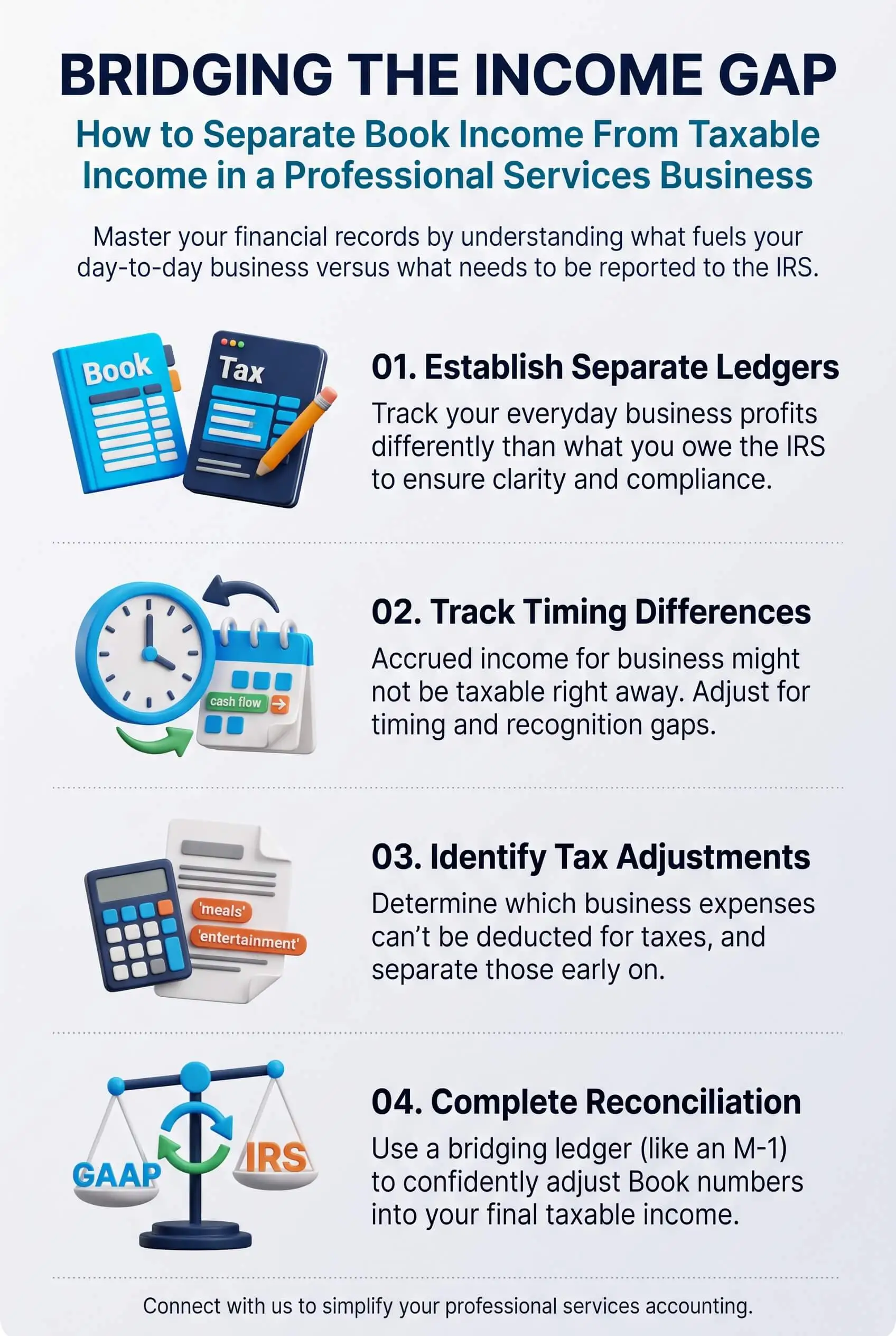
Separating book income from taxable income works best as a monthly habit rather than a year-end scramble. Here's how we'd set it up.
Choose both methods on purpose. Write down your book method and your tax method, and confirm each year that your firm still qualifies for the tax one.
Split out the tax-sensitive accounts. Give client meals, entertainment, gifts, penalties, owner draws, and guaranteed payments their own general ledger accounts. A single "meals and entertainment" bucket guarantees a scramble in March.
Run two depreciation schedules. Keep one for the books and one for federal tax. If you file in California, add a state column.
Update a book-to-tax bridge at every month-end close. Start with book net income, list each adjustment, and land on estimated taxable income. That bridge sits at the heart of specialized accounting for professional services firms, because someone owns it and it never waits for tax season.
Reconcile receivables, WIP, and retainers every quarter. Tie them to the bridge so your estimated tax payments follow what's actually happening instead of last year's number.
Give your CPA a clean package. Send the trial balance, bridge schedule, fixed asset roll-forward, and owner payment detail. For a corporation, that package feeds Schedule M-1, or Schedule M-3 once total assets reach $10 million, according to the IRS Instructions for Form 1120.
Worked Example: A 12-Person Marketing Consultancy
This one's hypothetical, though it follows a pattern we see all the time. A 12-person Los Angeles consultancy keeps accrual books and files on the cash method. Firms like this usually sort out pricing first, and this guide to calculating the right fee for a marketing consultant helps if you're still working out rates.
Book net income: $410,000
Plus receivables and WIP collected from last year beyond new year-end balances: +$64,000
Plus year-end bonuses accrued but paid in January: +$9,500
Plus 50% of $18,000 in client meals: +$9,000
Plus client event tickets, treated as entertainment: +$6,000
Plus a late-filing penalty: +$1,500
Minus bonus depreciation over book depreciation on $40,000 of new equipment: -$32,000
Federal taxable income: $468,000
That's the $58,000 from the top of this article, line by line. The receivables, bonus, and depreciation adjustments are temporary, so they'll swing back next year. The meals, entertainment, and penalty lines total $16,500, and they won't. Once a partner sees which is which, the surprise becomes a forecast. Understanding these differences is equally important in accounting for nonprofits, where accurate financial reporting and proper tax treatment help organisations maintain compliance and plan ahead.
When to Bring in Outside Help
Bring in help when partners spend billable hours untangling the books, when you cross a method threshold for the first time, when you start taking work in other states, or when an estimated tax bill shows up out of nowhere. Any one of those tells you the bridge between book and tax doesn't have an owner yet. Professional accounting services can help close that gap by keeping financial records accurate, tax obligations organized, and reporting aligned with your firm's needs.
"The firms that get surprised at tax time rarely have bad books. What they have is books nobody reconciles to the return until March. With the professional service firms we work with, the biggest swing usually comes from unbilled work and receivables, not obscure deductions. Once the book-to-tax bridge gets updated at every month-end close, partners know their tax picture in October instead of April, and they can plan draws and hiring around it."
7 Essential Resources
When a partner wants to understand the rules behind their own book-to-tax gap, these are the sources we send them to.
IRS Publication 538, Accounting Periods and Methods. The IRS walks through cash and accrual methods, the gross receipts test, and the exception for qualified personal service corporations.
IRS Publication 946, How To Depreciate Property. Lays out current Section 179 limits, the restored 100% bonus depreciation, and how MACRS works, with a section on what's new for 2026.
IRS Instructions for Form 1120. Covers personal service corporations, the nonaccrual experience method for service providers, and the point where Schedule M-3 replaces Schedule M-1.
Deloitte Roadmap on Permanent Differences. Offers a detailed reference table of the permanent book-tax differences that come up most under U.S. tax law.
AccountingTools on Permanent Differences. Explains permanent differences in plain language, using meals, penalties, and municipal bond interest as examples.
NATP on Section 448(c) Benefits. Breaks down the 2026 gross receipts threshold and the accounting shortcuts it opens up for smaller firms.
KDA on California Equipment Depreciation. Shows why California returns need their own depreciation schedule and how the state's $25,000 Section 179 cap works.
These resources explain the key tax rules behind book-to-tax differences, such as cash and accrual accounting, depreciation, permanent adjustments, and IRS reporting requirements. For professional services firms like a multicultural marketing agency, understanding these rules helps reconcile financial records with taxable income, avoid costly reporting errors, and make informed decisions about tax planning and compliance.
3 Statistics
90% of small business owners used a professional tax preparer for their most recent return, according to the NFIB 2024 Tax Survey. Almost every firm hands its return to a CPA. What you actually control is the quality of what you hand over.
23% of small business owners often or always feel unclear about their compliance obligations, and 25% have received a compliance-related warning, fine, or citation. LegalZoom surveyed 1,000 owners in December 2025 to reach those figures. Uncertainty and penalties tend to travel together, and a penalty also becomes a permanent book-tax difference, so you pay for it twice.
The 2026 federal Section 179 limit is $2,560,000, with a phase-out starting at $4,090,000 in qualifying purchases, per IRS Publication 946. California caps the same deduction at $25,000, which is how one equipment purchase ends up with three different numbers at a Los Angeles firm.
Final Thoughts and Opinion
Every professional services firm has a gap between book income and taxable income, and that's fine. Problems start when nobody at the firm can explain it.
In our experience, the firms that struggle at tax time rarely have the biggest differences. They're the firms that look at the difference once a year, after the books close and with the filing deadline only weeks away. By then the questions cost more, and the answers get rushed.
Good accounting for professional services firms builds the book-to-tax bridge into the monthly close, right alongside bank reconciliations and WIP reviews. Do that and the return stops being a surprise. It becomes a number you saw coming months ahead, with time to plan partner draws and hiring around it.
Frequently Asked Questions
Is book income the same as net income?
In most small firms, yes. Book income is the net income your financial statements show under your chosen accounting method. The tax return starts from it, but it's rarely the final taxable figure, because the tax code adds back or subtracts items it treats differently.
Why is my taxable income higher than my profit?
Usually it comes down to nondeductible expenses or timing. Your preparer adds back client entertainment, penalties, and half of your business meals. If you file on the cash method, collecting last year's receivables also raises this year's taxable income, while accelerated depreciation can pull it the other way.
Can a professional services firm keep accrual books and file taxes on the cash method?
Often, yes. Qualified personal service corporations can generally use the cash method regardless of size, and other firms can if their average gross receipts for the prior three years stay at or under $32 million for 2026. Plenty of firms run accrual books for management and file cash-basis returns.
What's the difference between permanent and temporary book-tax differences?
A temporary difference is a timing gap that reverses in a later year, such as depreciation or uncollected receivables. A permanent difference, like nondeductible entertainment or a fine, never reverses. Permanent differences change the total tax you pay, while temporary ones only change when you pay it.
Who has to file Schedule M-1 or Schedule M-3?
Corporations reconcile book income to taxable income on Schedule M-1. According to the IRS Instructions for Form 1120, corporations with $10 million or more in total assets at year-end must file the more detailed Schedule M-3 instead. Partnerships and S corporations have their own versions on their returns.
Are owner draws deductible for a professional services firm?
No. Partner draws and shareholder distributions aren't business expenses. Guaranteed payments to partners and reasonable W-2 wages paid to S corporation owners are deductible, and keeping them in separate accounts is one of the simplest ways to keep book and tax lined up.
Does California follow federal bonus depreciation?
No. California doesn't allow federal bonus depreciation, and it limits Section 179 expenses to $25,000. Firms that file there need a separate state depreciation schedule, so the same asset can produce different book, federal, and state numbers.
Know Your Tax Picture Before Filing Season
If your partners can't explain the gap between last year's P&L and last year's return, that's worth a conversation. Accountix is based in Santa Barbara, California, and provides bookkeeping, outsourced accounting, and fractional CFO support for professional service firms. We work alongside your tax preparer so the numbers they receive arrive reconciled and explained.
Book a 30-minute intro call with Accountix. No sales pitch, just clarity on where your book income and taxable income stand today, and what it would take to see both every month.


