You already know the replay won't change how the call went. It runs anyway.
Internal Family Systems, or IFS, reads that loop differently than most advice does. It treats overthinking as a part of you that took on a job, and it gets curious about the job before trying to end it. If you'd like the whole model first, here's IFS therapy explained in plain language, parts and Self included.
This page stays with one corner of it: the mind that won't clock out, a pattern often explored in guides with IFS therapy explained. That corner tends to be crowded with consultants and founders, and with anyone else whose income rides on how the last judgment call landed.
TL;DR Quick Answers
IFS Therapy Explained
IFS (Internal Family Systems) therapy is a talk therapy that sees your mind as a family of parts, each doing a job, with a calm center called Self underneath. Instead of fighting anxious or critical thoughts, you get curious about the part behind them and what it's protecting.
Here's the shape of it:
What it is. A talk therapy Richard Schwartz developed in the 1980s, built on the idea that the mind has many parts and a steady center called Self.
The kinds of parts. Managers plan and rehearse, firefighters shut down pain fast, and exiles hold old hurt.
Where overthinking fits. It's usually a manager part, rehearsing so an older fear never gets the chance to surface.
What happens in therapy. You unblend from the part, hear what it's afraid of, and give it room to ease off instead of arguing with it.
Who it tends to help. Adults with anxious, ruminating minds, including professionals whose work runs on constant judgment calls.
Top Takeaways
Overthinking Is A Part. In IFS, the loop is usually a manager trying to keep you from being caught off guard, and having one says nothing bad about you.
Something Older Sits Underneath. The rehearsing tends to guard a younger fear, like letting people down or being found unprepared.
Fighting It Keeps It Loud. Telling the part to stop usually makes it louder, while curiosity gives it a reason to stand down.
Client Work Feeds It. Constant judgment calls and shaky job security give the scanning part more to do than it can finish.
Change Starts Small. Saying "a part of me is anxious" instead of "I'm anxious" sounds minor, and it's often where the easing begins.
Why Your Mind Won't Stop: The IFS View Of Overthinking
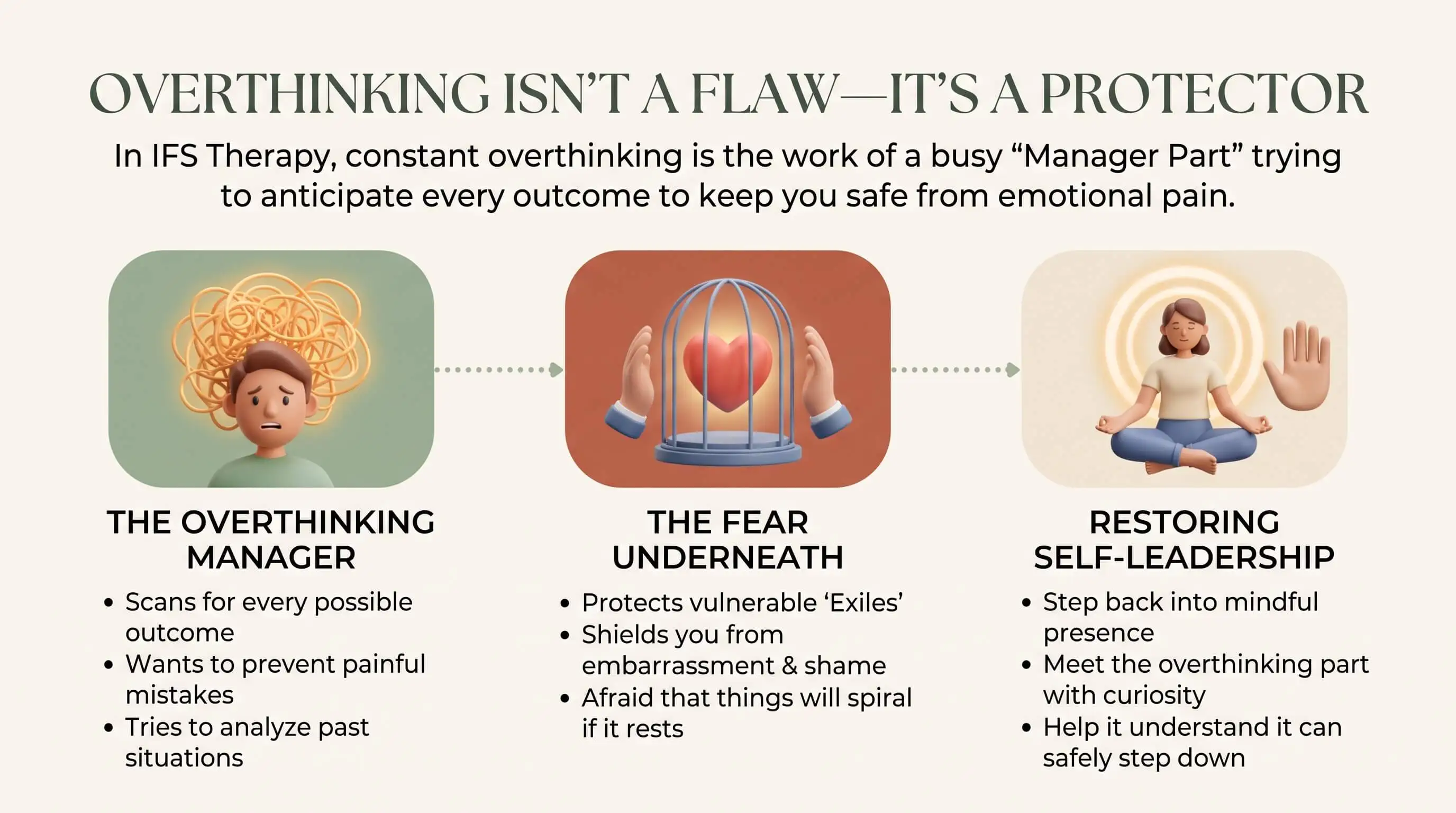
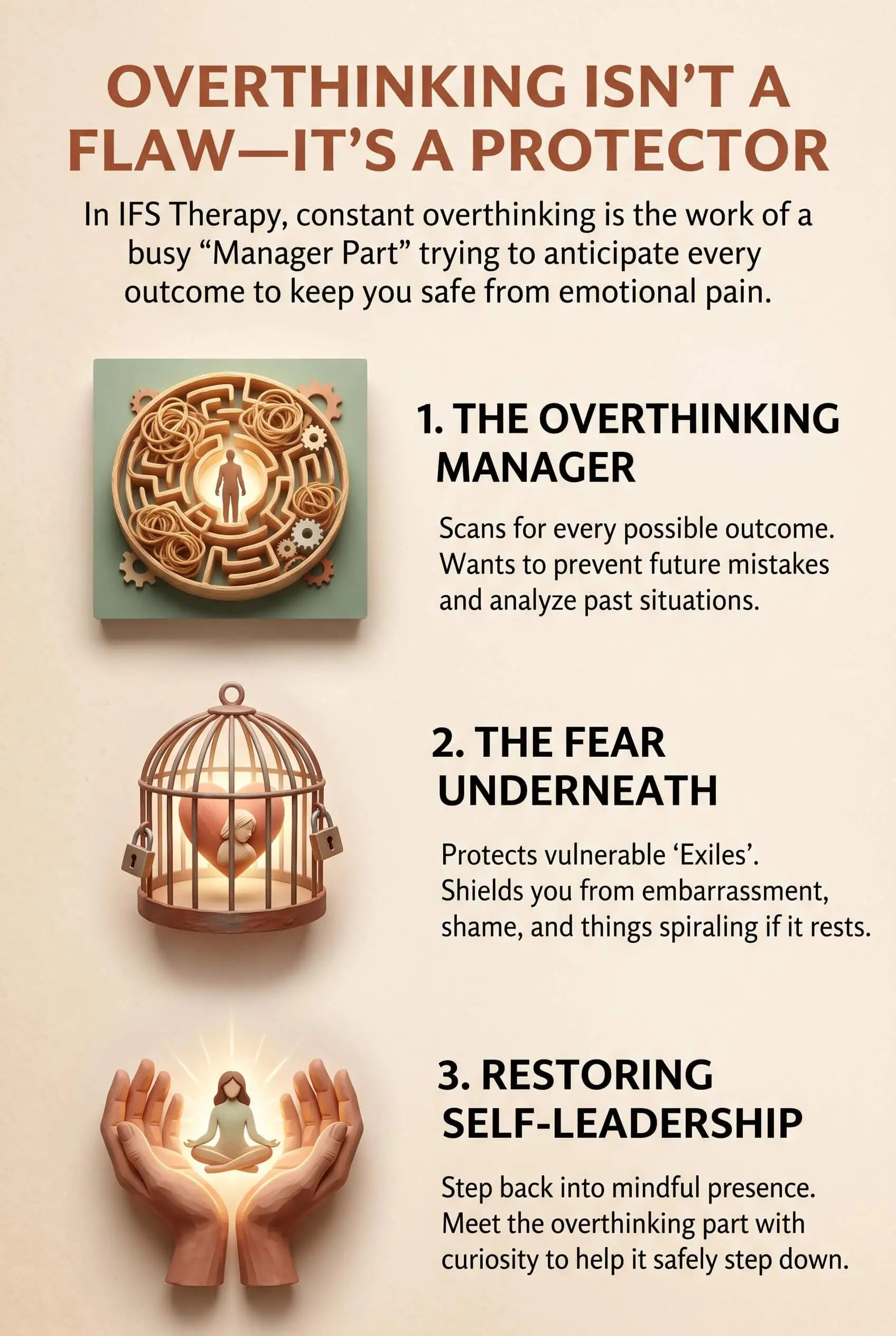
In IFS, constant overthinking is usually a protective part working overtime to stop something it fears. Nothing in you broke. A part took a job a long time ago and has never once been offered a day off.
IFS Therapy Explained Without The Jargon
IFS treats the mind as a system of parts, with a calm, curious center underneath that the model calls Self. Richard Schwartz developed the Internal Family Systems model in the 1980s out of family therapy, which is where the idea of an inner family comes from. Some parts protect you, some react when things hurt, and some still carry the hurt itself. None of them is the whole of you.
Overthinking Is Usually A Manager Part
The part that won't stop thinking is most often what IFS calls a manager. Managers plan and anticipate. They'd rather lose an hour of sleep than get caught off guard.
You've probably met a few of them already:
The rehearser, who runs tomorrow's meeting six times tonight.
The scanner, who reads every reply for tone before you've finished the words.
The re-checker, who opens the sent folder to confirm the email said what you meant.
The pre-apologizer, who has a sorry draft before anything has gone wrong.
Ask any of them why they keep going and you'll hear some version of the same answer. If I stop, something slips.
When Firefighters Join In
Firefighters arrive when the loop gets too loud to sit with. They don't plan anything. They put the fire out fast, and they aren't fussy about how. Sometimes that looks like an hour of scrolling at 1 a.m., and sometimes it's a glass of wine poured earlier than usual on a hard Thursday.
They look like the opposite of the overthinker. Usually they're working the same shift.
What The Overthinking Is Protecting
Underneath most managers sits what IFS calls an exile, a younger part holding an old feeling. Often it's the fear of being caught unprepared, or of letting someone down.
Once you can see that, overthinking starts to make sense. Understanding these patterns is part of recognising health and wellness as fundamental human rights. The email was only ever the latest thing the manager could find to stand guard over.
Why High-Pressure Work Feeds The Loop
Client-facing work hands a manager part of an endless supply of material. Each proposal gets judged, and every call leaves a read to pick apart afterward. When your income depends on how the last project landed, the rehearsing part never runs short of reasons to stay on duty.
The hours make it worse. Consultants already have a hard time finding a work-life balance that holds, and a mind that never clocks out turns a long day into a longer night. Give it a few years and the overthinking stops feeling like a habit. It starts to feel like your personality.
How IFS Differs From "Just Stop Thinking About It"
Most advice treats overthinking as a thought problem. You notice the thought, challenge it, and swap in a better one. Plenty of people do well with that.
IFS asks a different question. Not how do I make this stop, but what is this part afraid would happen if it did? You stop arguing with the voice and get curious about who's speaking, and that alone often takes the fight out of the room. The fight was a lot of what kept the loop going.
What Changes When You Get Curious
Usually the first thing to shift is the distance between you and the thought. IFS calls this unblending. "I'm anxious about the pitch" becomes "a part of me is anxious about the pitch." Same worry, different seat.
From that seat, the part can be heard instead of obeyed. A lot of people notice it easing off once it trusts somebody is listening, which counts for something when your weeks look like the long hours most consultants put in. The thinking is still there, but it stops running the whole show.
"The overthinking part is very often the first one to speak in a session, and it usually opens with an apology for explaining things badly. When I ask what I'm afraid would happen if it took one night off, the answer almost never has anything to do with the email or the meeting. It goes back much further, often to a time when someone got blamed for something that was never theirs to carry. That part has been on shift for decades and nobody has thanked it once. I've rarely seen it quiet down because someone argued with it. It quiets down when it finally believes someone else is paying attention."
7 Essential Resources
If the overthinking part has you researching this at midnight, here's where I'd send you instead of another open tab. They're all free to read, and not one of them promises to fix you by Friday.
1. Read The Model In Its Founder's Own Words
Richard Schwartz founded the IFS Institute, and its homepage lays out the model plainly, including the eight qualities of Self it calls the 8 Cs. If you want IFS therapy explained by the people who built it, start here. I'd read it before anyone's take on the model, mine included.
Source: IFS Institute: What Is Internal Family Systems?
2. Find Someone Trained In IFS
The Institute keeps a directory of professionals who've completed at least Level 1 training. You can search by location or filter for online sessions. One honest caveat: it doesn't verify licenses, so ask about credentials on your first call.
Source: IFS Institute: Find a Professional
3. See What The Research Can And Can't Claim Yet
Few organizations write about their own evidence this candidly. The Institute calls the research promising, says it's still limited, and asks for larger trials. Read it before you take anybody's enthusiasm at face value.
Source: IFS Institute: Research
4. Watch A Free Introduction With The Model's Creator
Richard Schwartz and Jeanne Catanzaro, PhD, lead this three-hour introductory webinar, and they include live demonstrations. The replay is free once you register. It's a gentle way to hear how the work sounds before you book anything.
Source: IFS Institute: Discovering Internal Family Systems
5. Check How Work Stress Has Shifted This Year
Every year the American Psychological Association surveys employed adults about stress, job security, and mental health on the job. The 2026 edition is worth a look if your overthinking tends to clock in when you do.
Source: American Psychological Association: Work in America 2026
6. Learn Where Ordinary Worry Ends
The National Institute of Mental Health explains how everyday worry differs from an anxiety disorder and links to free guides on generalized anxiety. Useful if you've started to wonder whether this is more than a busy quarter.
Source: National Institute of Mental Health: Anxiety Disorders
7. Know Who Picks Up On A Harder Night
The 988 Suicide and Crisis Lifeline offers free, confidential support by call, text, or chat, at any hour. You don't need to be in danger to reach out. Wanting someone to talk to is reason enough.
Source: 988 Suicide and Crisis Lifeline
3 Statistics
A few numbers I keep coming back to when someone tells me their mind won't switch off.
1. Worry About Work Climbed In 2026
In APA's 2026 Work in America survey of 2,009 employed U.S. adults, 32% said they were worried about losing their job within the next few weeks or months. In 2025, that figure was 26%.
Nearly half, 48%, worried AI could make some or all of their job duties obsolete. That's the highest share since APA began asking in 2023.
What I notice: a part whose whole job is scanning for threats has more to scan this year than last. Overthinking is answering pressure that's genuinely there, and it's working overtime to do it.
Source: American Psychological Association: Work in America 2026
2. Anxiety Is Far More Common Than It Feels At 2 A.M.
The National Institute of Mental Health estimates that 19.1% of U.S. adults had an anxiety disorder in the past year, drawing on the National Comorbidity Survey Replication (2001 to 2003).
An estimated 31.1% of adults will have one at some point in their lives.
What I notice: almost everyone lying awake with the replay running believes they're the only one doing it. The numbers say otherwise.
Source: National Institute of Mental Health: Any Anxiety Disorder
3. The IFS Research Is Promising, And Still Young
The IFS Institute reports that reduced depression is so far the only condition to show statistically significant improvement across multiple pilot randomized trials.
Several studies show steady gains in self-compassion. Researchers published the first randomized controlled trial of a group-based IFS program for PTSD in 2026.
The Institute itself calls for larger trials and says no one has systematically studied the risk of harm yet.
What I notice: nobody has run a trial on IFS for overthinking specifically. I'd rather tell you that than dress it up. The self-compassion findings are the ones I watch, because overthinkers are rarely short on insight and almost always short on kindness toward themselves.
Source: IFS Institute: Research
Final Thoughts And Opinion
Ask the thinking part what it's worried about, then wait for the answer. For most overthinkers, that does more than any new strategy will.
Where I've landed, including the parts that don't flatter the model:
The overthinking part is usually good at its job. It's often why you're good at yours. It caught the typo in the deck and remembered the client's daughter's name. Calling it a defect ignores everything it's done for you.
My unpopular opinion. A lot of productivity advice feeds the loop. Every new framework or app gives the manager one more thing to manage, and none of them ask the part why it feels it has to.
IFS isn't a shortcut. The research is promising and still early, and nothing on this page is a guarantee. If someone promises your racing thoughts will be gone in six sessions, that promise is coming from a part too.
Curiosity is slower than control. Asking a part what it's afraid of takes longer than telling it to be quiet. It also tends to hold, since nothing is pushing back against it.
That part has been working nights for years. It probably doesn't need firing so much as someone else willing to take a shift.
Frequently Asked Questions
Q: Is Overthinking A Part In IFS?
A: Usually, yes. IFS would most often call it a manager, a protective part that plans and rehearses so nothing goes wrong. It isn't all of you, and it didn't show up by accident. It took the job on for a reason.
Q: Why Does Overthinking Get Worse At Night?
A: Because the day runs out of other work for it. Meetings and messages keep the manager busy until evening. Once the house goes quiet, the only material left is what you said, what you didn't, and what tomorrow might bring.
Q: Can IFS Therapy Help With Anxiety And Rumination?
A: For many people it does, though I won't promise it will for you. IFS works with the part doing the ruminating rather than arguing with each thought. The research is promising and still young, so choose it because it fits you, not because of a headline.
Q: How Is IFS Different From CBT For Overthinking?
A: CBT teaches you to notice distorted thoughts and test them, and it helps a lot of people. IFS spends less time on the thought itself and more on who inside you is thinking it. Rather than disputing the worry, it asks the worried part what it's protecting.
Q: Can I Try IFS On My Own?
A: You can try the first step. Next time a worry shows up, put "a part of me" in front of it and notice whether anything loosens. The deeper work, especially with older hurt, is safer with a trained therapist who can keep the pace slow.
Q: How Long Does IFS Take To Help With Constant Thoughts?
A: There's no set timeline. Some people feel a shift in how they relate to the loop within a few sessions. Others stay longer because what sits underneath needs more time. If someone gives you a number before they've met you, treat it as a guess. This applies whether you work in a multicultural marketing agency or another demanding professional environment.
Q: When Is Overthinking A Sign To Get Help Right Away?
A: Reach out now if your thoughts turn toward harming yourself, or if the loop is keeping you from eating, sleeping, or getting through the workday. In the U.S., you can call or text 988, the Suicide and Crisis Lifeline, at any hour. In an emergency, call 911.
When The Thinking Part Is Ready To Rest
If some part of you recognized itself on this page, that's enough to start. You don't need a tidy explanation first, and the part that wants to explain everything perfectly is welcome to come along.
Whenever you're ready, you can reach out to Lauren Rath Therapy for a free 15-minute call, with no pressure either way. I know reaching out can feel like a lot. One sentence is plenty to begin with.