Your P&L says you had a strong year, and your bank account says Friday's payroll goes on the company card again. A fractional CFO can usually close that gap, because in a profitable business the cause is almost always timing, visibility, or working capital rather than a lack of money.
Owners of agencies, consultancies, and other service firms tell us this story all the time. The work is good and clients are happy, yet cash runs thin at exactly the wrong moments.
Your books record profit the day you earn it, but your bank only sees it when a client pays. Deposits, tax bills, and new hires all land somewhere in that window. When you bring in virtual fractional part-time CFO services from Accountix, you get a finance leader whose job is to spot those timing gaps early, plan around them, and help you act before they turn into a crunch.
TL;DR Quick Answers
Hire the Best Virtual Fractional Part Time CFO Services
The best virtual, fractional, or part-time CFO puts a working cash forecast in your hands within 30 days and uses it to guide real decisions, well beyond monthly reporting.
Ask what you'll have after 30 days. A rolling 13-week cash forecast with scenario planning is the benchmark.
Check industry fit. Look for experience with businesses your size and your billing model, whether that's retainers or project work.
Confirm they work from clean books. Ask how they coordinate with your bookkeeper or controller, since CFO guidance is only as strong as the numbers behind it.
Compare the real cost. Accountix's fractional CFO service starts at $350 per week, while a full-time CFO can cost more than $200,000 a year.
Know when to hire. Businesses above roughly $2 million in revenue, or facing hiring, expansion, or repeat cash crunches, usually see the most value.
Start with a conversation. A 30-minute intro call with no hard sell should tell you whether the fit is there.
Can a fractional CFO fix cash flow problems in a profitable business? Usually, yes. When the problem is timing, visibility, or working capital, a fractional CFO can forecast the gaps and change how and when cash comes in.
Why doesn't profit equal cash? Profit counts revenue when it's earned, and cash counts it when it's collected. Receivables, upfront costs, debt payments, and owner draws open up the gap.
What's the first thing a fractional CFO builds? Most start with a rolling 13-week cash flow forecast, so payroll, taxes, and large bills show up well before they're due.
Who needs a fractional CFO? Growing businesses facing big decisions or repeat cash crunches that want senior financial guidance without adding a full-time executive salary.
Top Takeaways
Profit is what you earned, and cash is what you can spend this week.
Slow receivables, upfront costs, and growth cause most of the cash gaps we see.
A rolling 13-week forecast is usually the first fix and the most useful one.
A fractional CFO can't rescue an unprofitable model or build on messy books.
Choose a partner who puts a working forecast in your hands within 30 days.
Why Do Profitable Businesses Run Out of Cash?
Profit tells you what you earned. Your bank balance tells you what you can spend this week, and in the service firms we support, the distance between those two numbers traces back to a short list of causes.
Five Places Profit Gets Stuck Before It Becomes Cash
Slow receivables. Clients pay on net-30 or net-60 terms while your team gets paid every other Friday.
Upfront costs. You pay for media buys, freelancers, and software seats before the client pays you back. If you run campaigns for clients, connecting marketing spend to cash flow matters as much as tracking clicks and leads.
Growth that eats cash. A new hire costs you from day one and may not cover her own salary until month four.
Debt payments and owner draws. Loan principal and distributions pull money out of the account, and neither one appears as an expense on your P&L.
Lumpy bills. Estimated taxes, insurance renewals, and annual contracts tend to pile into the same few months.
Picture a firm running a 15% margin with clients on 60-day terms. Payroll and rent hit on day 30. The firm has earned the money and it's on the way, but for the next four weeks it can't cover a single bill. That’s exactly when it makes sense to hire the best virtual fractional part time CFO services.
What Does a Fractional CFO Actually Do About It?
A fractional CFO is a senior finance leader who works with your business part-time and brings forecasting and planning without a full-time executive salary. The role is one version of the broader fractional executive model. It fits companies that need experienced judgment more than another permanent seat.
On cash flow, the work maps straight onto the leaks above:
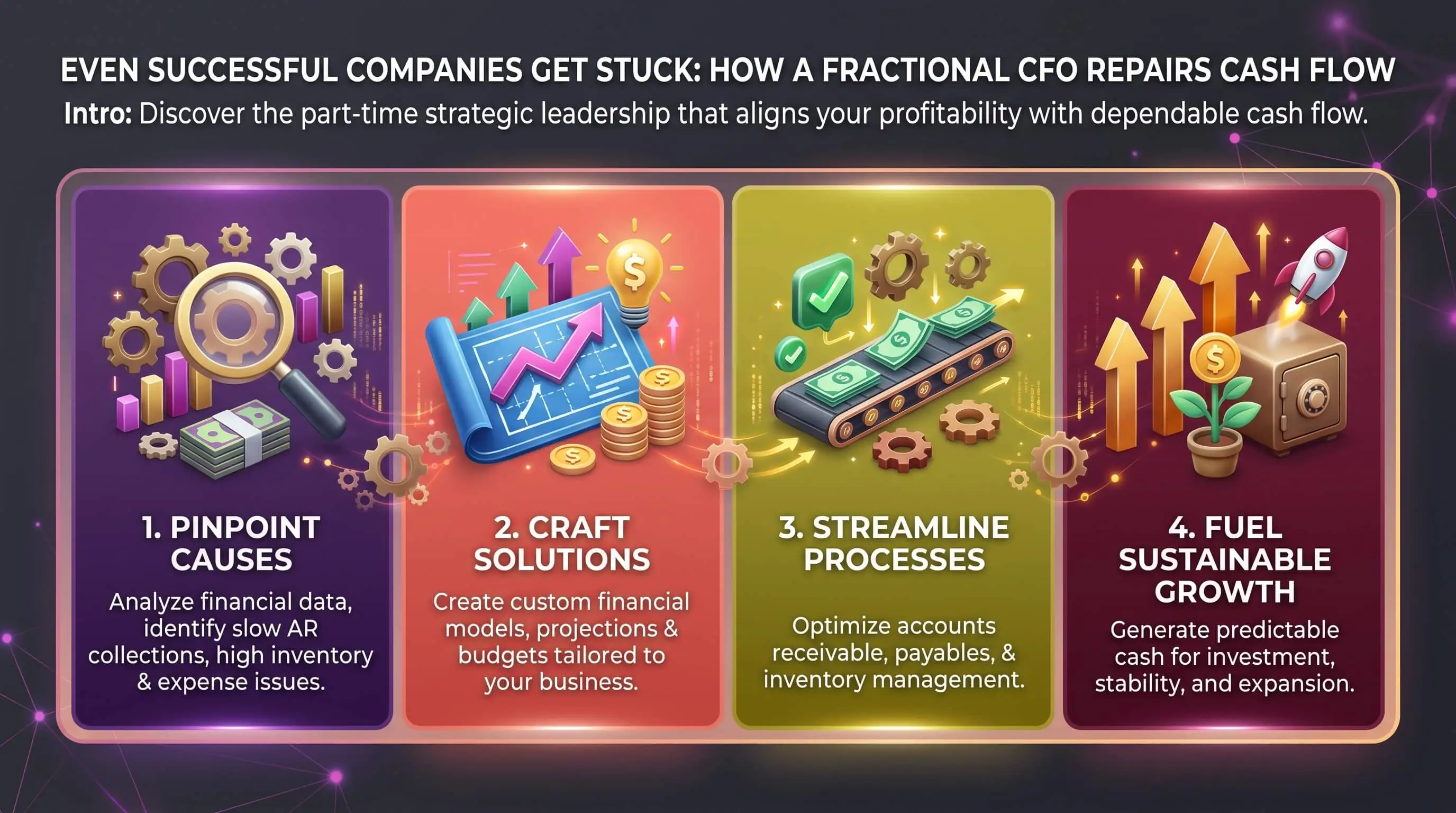
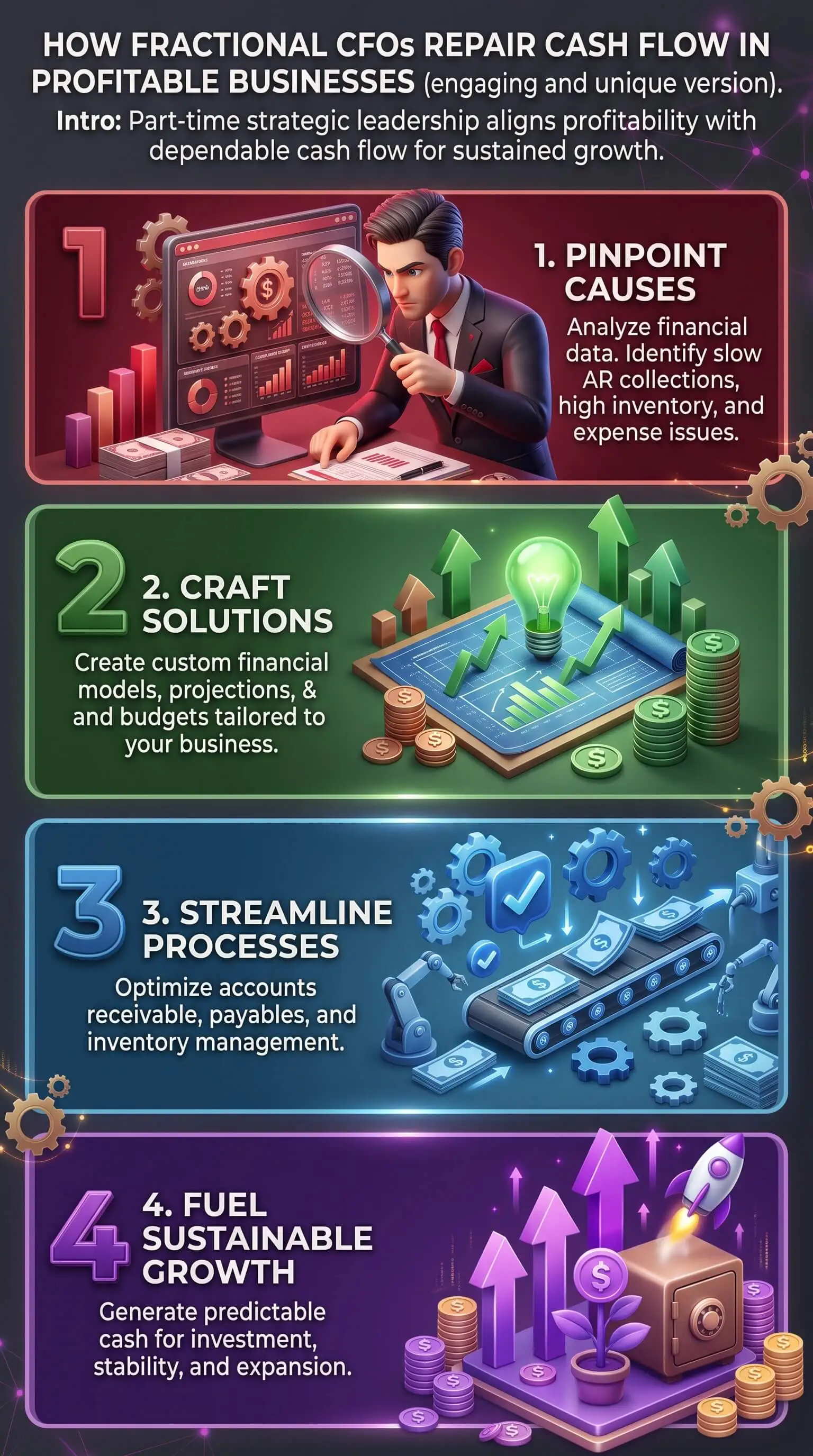
A rolling 13-week cash flow forecast. You see payroll, taxes, and big renewals weeks ahead instead of the morning they're due.
Better billing and terms. Your CFO sets up deposits, milestone billing, and shorter terms so money arrives sooner.
Client-level profitability. Some clients look great on the P&L and tie up cash for months. Once you know which ones, you can price and staff them differently.
Hiring and payroll models. Your CFO tests each growth plan against your real cash position before an offer letter goes out.
Scenario planning. What happens if your biggest client pays 45 days late? You'll have the answer and the plan in hand ahead of time.
Financing lined up early. Banks say yes more easily when your numbers look strong, and that's exactly when most owners forget to ask. If you handle running payroll yourself, a standby line of credit takes a lot of pressure off slow months.
The First 90 Days: How the Fix Usually Unfolds
Weeks 1 and 2. Your CFO reconciles the books and pulls together a clear picture of receivables, payables, and recurring bills.
Weeks 3 to 6. You get a 13-week forecast, a ranked list of leaks by dollar impact, and agreement on what to fix first.
Weeks 7 to 10. You and your CFO update billing terms, shift spending to match collections, and set up any financing you need.
Weeks 11 to 13. You settle into a weekly cash review that keeps decisions ahead of the numbers.
What a Fractional CFO Cannot Fix
A fractional CFO can't make a business that loses money on every project profitable. No forecast will raise prices you've already decided to hold. The work also needs reliable books to stand on, so if your bookkeeping is months behind, fix that first, often with a controller or outsourced accounting team working alongside the CFO.
How to Hire the Best Virtual, Fractional, or Part-Time CFO Services
Fit matters more than credentials. When you talk to firms, ask about:
Their experience with businesses your size and in your industry
What you'll have in hand after 30 days, where a working cash forecast is a strong answer
How pricing works and whether they lock you into a long contract
How they'll work with your current bookkeeper or accounting team
Case studies that show outcomes rather than activity
It also helps to know where the role sits next to the people you may already have:
Bookkeeper or controller: keeps the records and runs the monthly close, so you have an accurate history of what already happened.
Fractional CFO: works with you weekly or monthly on forecasting, planning, and the decisions ahead.
Full-time CFO: a salaried executive who owns the entire finance strategy.
Then there's cost. Accountix puts an in-house CFO at more than $200,000 a year for that one role. Its fractional CFO service starts at $350 per week and scales with what you need.
"Almost every owner who calls us already knows the business is profitable. What surprises them is that the profit never seems to reach the bank. With the service firms we support, the first fix is rarely a spending cut. We build a 13-week forecast, then change when money comes in through deposits, milestone billing, and shorter terms. Once an owner can see three months of cash on one page, the 2 a.m. decisions stop."
7 Essential Resources
SBA: Manage Your Finances covers the bookkeeping and financial statement basics every forecast is built on.
Federal Reserve Banks: 2026 Report on Employer Firms tracks what small businesses across the country are borrowing for and struggling with right now.
JPMorgan Chase Institute: Cash Is King introduced "cash buffer days," a quick way to see how long you could operate if payments stopped coming in.
QuickBooks 2026 Small Business Late Payments Report shows how overdue invoices and slow payment processing pile up for small firms.
IRS Publication 538: Accounting Periods and Methods lays out cash versus accrual accounting. That difference is why your P&L and your bank account can disagree.
SCORE: 12-Month Cash Flow Statement Template is a free spreadsheet for mapping money in and out by month. It's a solid starting point before a full rolling forecast.
Wikipedia: Cash Conversion Cycle explains the metric for how many days your cash stays tied up between paying for work and getting paid for it.
3 Statistics
56% of small employer firms that applied for financing did it to cover operating expenses, according to the Federal Reserve Banks' 2026 Report on Employer Firms. Borrowing to pay ordinary bills usually points to a timing problem, not a profit problem.
The median small business holds only 27 cash buffer days, and one in four holds 13 or fewer, according to the JPMorgan Chase Institute. A single client paying a month late can burn through most of that.
59% of small businesses have invoices at least 30 days overdue, up from 47% a year earlier, based on the QuickBooks 2026 Small Business Late Payments Report. Firms in that spot are owed $17,700 on average, all of it earned and none of it spendable yet.
With late payments, thin cash buffers, and operating expenses driving many financing needs, remote outsourced QuickBooks bookkeeping services online can help businesses keep their financial records current and give CFOs clearer numbers to spot cash-flow timing problems before they turn into a crunch.
Final Thoughts and Opinion
Here's where we land after working inside clients' books week after week: most cash problems in profitable businesses come down to what the owner can see. Today's bank balance won't warn you about the tax payment due in six weeks, or the client who always pays late in December.
That's why we believe the most valuable thing a fractional CFO delivers is a forecast you actually open every week. Owners who start reviewing cash weekly usually change their habits within a month or two, asking for deposits, timing hires around collections, and passing on projects that would tie up cash for a quarter. Very little of that involves cutting costs. All of it depends on seeing what's coming.
If the business loses money on the work itself, a CFO won't change that. If it's profitable and still feels tight, the fix is probably closer than you think. More revenue can wait. Start with clarity on when your money moves and a plan to move it on your schedule.
Why is my business profitable but always short on cash?
Your P&L counts revenue when you earn it, and your bank account counts it when the client pays. Slow receivables, project costs paid upfront, loan payments, owner draws, and big annual bills can all drain cash in a year that still shows a profit, whether you run a service firm, a multicultural marketing agency, or another growing business. It's usually a timing issue, which means you can plan for it.
What does a fractional CFO do for cash flow?
They build a rolling cash forecast, tighten billing terms and collections, look at profitability client by client, and test hiring or growth plans against the cash you'll actually have. You see shortfalls weeks in advance and have time to act before they turn into emergencies.
How much do fractional CFO services cost?
It depends on scope and complexity. Accountix's fractional CFO service starts at $350 per week and scales from there. For comparison, a full-time, in-house CFO can run more than $200,000 a year, which is more than most small and midsize businesses need.
When should a small business hire a fractional CFO?
When big decisions start outrunning what you can see in your numbers. Hiring, expansion, raising capital, and cash crunches that keep coming back are all common triggers. Accountix notes that businesses above roughly $2 million in revenue often get the most from it, though smaller firms with complicated billing can benefit too.
What is the difference between a fractional CFO, a controller, and a bookkeeper?
Your bookkeeper records transactions. A controller runs the monthly close and makes sure the books are accurate. A fractional CFO takes those numbers and uses them to forecast, plan, and guide decisions. Most businesses need solid bookkeeping in place first, with CFO support layered on top.
Ready to Turn Profit Into Cash You Can Use?
If the business is profitable and cash still feels tight, you shouldn't have to guess where it's going. Book a 30-minute intro call with the Accountix team to walk through your numbers and see whether fractional CFO support from outsourced business and financial accounting firms makes sense right now.
No hard sell. You'll leave with a clearer view of your cash either way.