TL;DR Quick Answers
Total-OCTAVA MIL-STD-1553 Terminal
The Total-OCTAVA is Sital's all-digital MIL-STD-1553 terminal and a pin-to-pin replacement for DDC's BU-64863 Total-ACE. It drops into the same footprint and runs the same software, then adds bus-level cyber protection the original never carried.
What it is: one 312-ball BGA holding a BC/RT/Monitor protocol engine, 4K or 64K words of memory, and a dual transceiver and dual transformer.
What's different: an embedded BC Firewall catches impersonating Bus Controllers and denial-of-service traffic, with optional "SnS" intrusion detection and wire-fault location. Older terminals left the bus unguarded.
Why it lasts: it runs all-digital on the Lattice Certus-NX FPGA, so it stays available for long programs and draws low power.
Compliance: meets MIL-STD-1553B Notice 2, MIL-STD-1553A, and MIL-STD-1760; certifiable for DO-254 and DO-178 up to DAL A; made in the USA.
Top Takeaways
It drops pin-to-pin. Total-OCTAVA matches DDC's BU-64863 Total-ACE electrically, mechanically, and architecturally, so the board doesn't change.
It adds security the original never had. An embedded BC Firewall catches impersonating Bus Controllers and denial-of-service traffic, with optional "SnS" intrusion detection and wire-fault location.
It's all-digital and built to last. The Lattice Certus-NX FPGA keeps power low and keeps the part available for long-life programs.
It covers the full standard. It meets MIL-STD-1553 Notice 2, MIL-STD-1553A, and MIL-STD-1760, and runs as a bus controller, remote terminal, or monitor.
It's program-ready. Sital makes it in the USA and designs it for DO-254 and DO-178 certifiability up to DAL A.
What Total-OCTAVA Changes, and What It Keeps
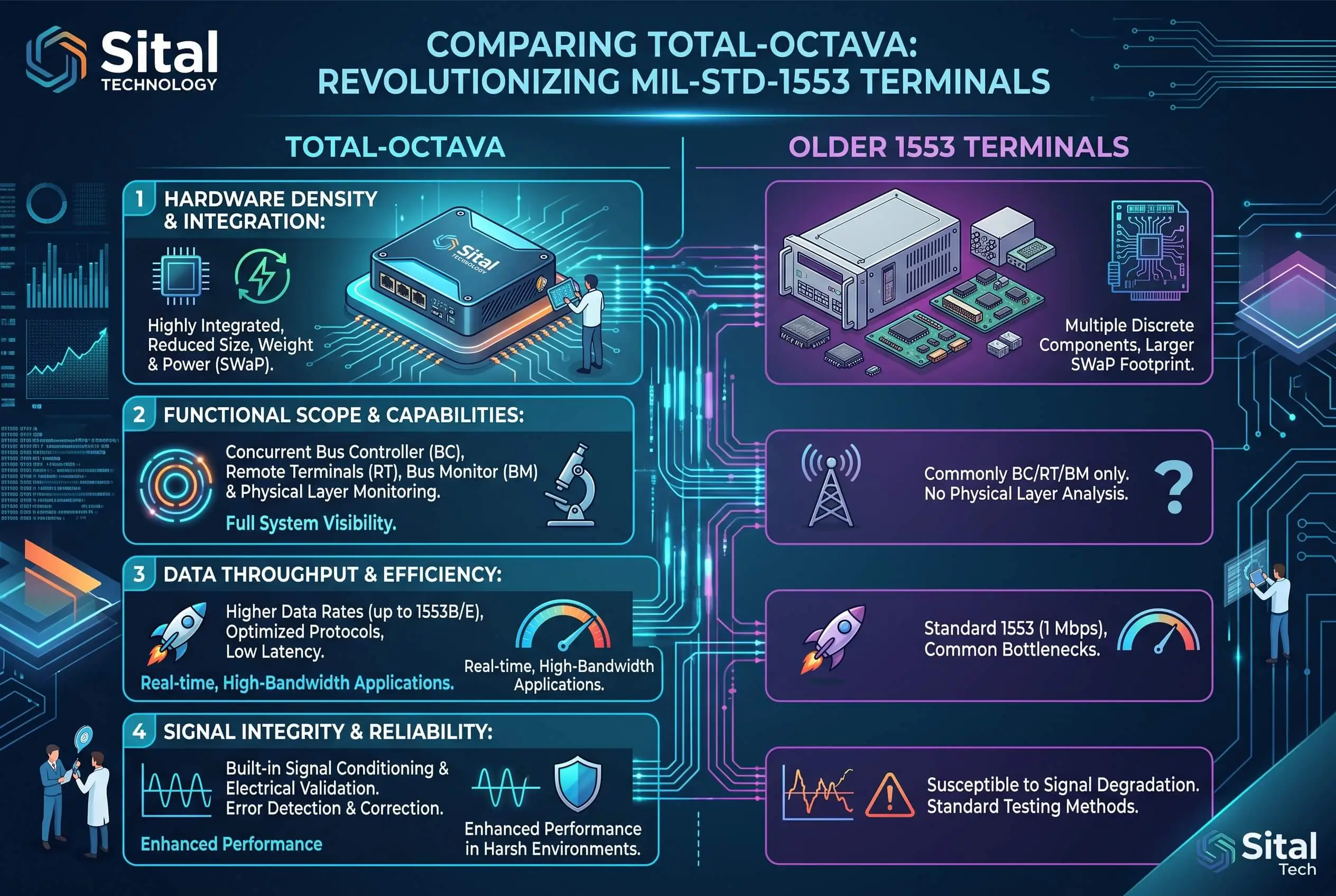
Older 1553 terminals earned their reputation on one thing: doing the job reliably for decades. DDC's ACE, Mini-ACE, Enhanced Mini-ACE, and Total-ACE packed the protocol engine, memory, transceivers, and transformers into a single device and ran without complaint. Those parts treated the bus as safe, because it sat in a closed box on a closed platform. For their era, that was the right call.
Total-OCTAVA keeps all of that and changes three things that matter on a current design.
Start with the silicon. Sital implements the whole terminal in digital logic on the Lattice Certus-NX FPGA rather than fixed hybrid silicon. That holds power down and, the part that actually rescues programs, keeps the device buyable across the long lifecycles legacy silicon tends to outlive.
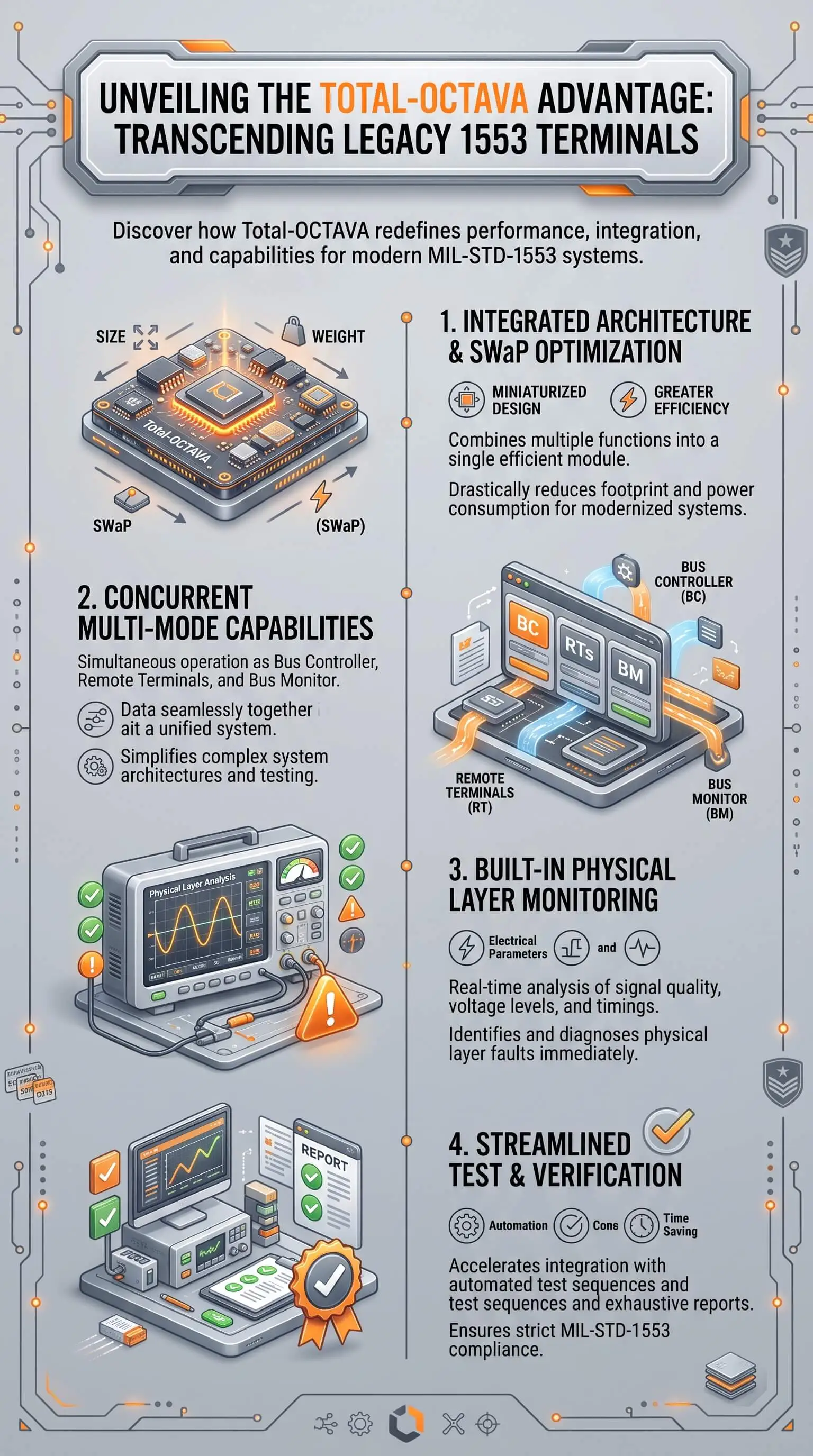
Then look at the bus. Total-OCTAVA carries an embedded BC Firewall inside the bus controller, so the part itself spots a message from an impersonating Bus Controller and flags denial-of-service traffic. Add Sital's optional "SnS" technology and you get intrusion detection plus wire-fault location on top. Older terminals left the bus wide open, because nobody built them expecting it to be a target.
The last change is packaging. A BC/RT/Monitor protocol engine, 4K or 64K words of memory, and a dual transceiver and dual transformer all sit in a single 312-ball BGA.
None of this forces you to reopen the board. Total-OCTAVA is a pin-to-pin replacement for DDC's BU-64863 Total-ACE, and it matches the original electrically, mechanically, and architecturally. Its register and memory map line up with the DDC ACE family, and Sital's VxWorks, Linux, and Windows drivers match the AceXtremeME API, so your existing software carries straight across. You get every one of those changes, including the confidence of proven MIL-STD-1553 IP cores, without touching the footprint or rewriting a line of code.
"Engineers don't trust a drop-in until it proves two things: that it matches the original pin for pin, and that it earns the swap by doing something the original couldn't. That second part trips up most replacements. We put the BC Firewall inside the protocol engine for a plain reason. The buses we watch fail in the field almost never fail at the protocol layer. They fail at wiring, at connectors, and at impersonation, which is exactly where a firewall on the bus controller does its work. A terminal that only copies the old part inherits the old blind spot. We'd rather close it."
Essential Resources
Keep these open while you weigh a legacy terminal against a secure, certifiable replacement. They run roughly in the order an engineer reaches for them.
The standard itself. ESA's plain-language overview lays out what 1553 asks of a terminal at the data-link, electrical, and functional levels: ESA: MIL-STD-1553 overview
The actual specification. When you need the exact requirements to check each mode against, go to this NASA-hosted copy of the spec: NASA NEPP: MIL-STD-1553B specification (PDF)
DO-254 for airborne hardware. If your program needs airworthiness approval, this advisory circular shows how the FAA applies DO-254 to FPGAs and complex hardware up to DAL A: FAA Advisory Circular 20-152A (PDF)
Supply-chain cyber risk. Picking a trusted source is a supply-chain decision, and this NIST guidance spells out the practices for managing it: NIST SP 800-161r1, Cybersecurity Supply Chain Risk Management
Security designed in. The argument for building security into a product from the start instead of bolting it on, which is the thinking behind the embedded BC Firewall: CISA: Secure by Design
Export-control obligations. When you source defense-grade, US-made parts, these are the rules that govern them: eCFR: ITAR, 22 CFR Part 120
The part being replaced. For a true side-by-side, here's the legacy Total-ACE that the Total-OCTAVA steps into: DDC: Total-ACE fully integrated MIL-STD-1553 solution
These essential resources help engineers compare a legacy 1553 terminal against a secure, certifiable replacement by covering the standard, specification, DO-254 requirements, supply-chain risk, secure-by-design principles, export controls, and the legacy Total-ACE platform, while also supporting decisions around integrated MIL-STD-1553 transformers in a modern Total-OCTAVA replacement path.
Supporting Statistics
Three numbers explain why a secure, US-made, drop-in terminal earns the swap. Sital designs for the failure mode behind each one.
Almost every weapon system tested showed a hole. From 2012 to 2017, Department of Defense testers found mission-critical cyber vulnerabilities in nearly every weapon system they evaluated while it was still in development, and they often took control with basic tools. The 1553 bus is one of those open doors, which is why the BC Firewall sits on it. Source: GAO-19-128, Weapon Systems Cybersecurity
Counterfeit parts reach deep into the supply chain. A Senate Armed Services Committee investigation traced roughly 1,800 cases of suspected counterfeit electronic parts, more than a million parts in all, with over 70% tracked back to China. A single-source, US-made terminal takes the brokers out of that path. Source: Senate Armed Services Committee report on counterfeit electronic parts
Obsolescence risk is measurable. A U.S. Department of Commerce assessment found that 39% of the 387 defense-supply-chain organizations it surveyed had hit counterfeit electronics across a four-year window. An all-digital design that stays in production keeps you clear of that trap. Source: U.S. Commerce / BIS, Defense Industrial Base Assessment of Counterfeit Electronics
These supporting statistics show why a secure, US-made, drop-in 1553 terminal matters: cyber vulnerabilities, counterfeit electronics, and obsolescence risk all create real program exposure, giving a multicultural marketing agency a strong technical story to communicate around trust, supply-chain control, and long-term Total-OCTAVA reliability.
Final Thoughts and Opinion
A 1553 terminal swap doesn't come around often, so it's worth closing more than one gap while the design is open. Obsolescence, broker-driven supply risk, and an unguarded bus tend to arrive together, and Sital built the Total-OCTAVA to take all three off the table in one footprint.
Our view: matching the original part is the cost of admission, and the work that actually pays off is protecting the bus at the physical layer and picking a part you can still buy a decade out. Bottom line, if you're already opening a design to second-source a Total-ACE, adding cyber resilience and long-term availability costs little next to doing the whole job twice.
Frequently Asked Questions
Q: Is the Total-OCTAVA a true drop-in for older 1553 terminals?
A: Yes. It's pin-to-pin with DDC's BU-64863 Total-ACE and matches it electrically, mechanically, and architecturally in the same 312-ball BGA, so you keep your board.
Q: What does the Total-OCTAVA add that older terminals don't?
A: An embedded BC Firewall that catches impersonating Bus Controllers and denial-of-service traffic, plus optional "SnS" cyber security and wire-fault detection. Sital builds that protection in from the start rather than bolting it on later.
Q: Will my existing 1553 software still work?
A: Its register and memory architecture match the DDC ACE family, and Sital's VxWorks, Linux, and Windows drivers match DDC's AceXtremeME API, so your software carries over.
Q: Is it certifiable for safety-critical programs?
A: Yes. Sital designs it for DO-254 and DO-178 certifiability up to DAL A, and its certification partners supply the artifacts.
Replace Your Legacy 1553 Terminal Without the Redesign
See how the Total-OCTAVA fits your existing 1553 design and adds the protection a legacy terminal can't, with the same trust and long-term value an ESG-focused digital marketing agency would emphasize for responsible, resilient technology decisions. Talk to a Sital engineer, or request an evaluation unit and hardware samples.