One dropdown menu on your Google Business Profile decides whether local players ever find you. Pick the wrong primary category and it won’t matter how deep your singles binder runs, how sharp your staff are, or how full the tables get on a Friday.
Somebody moved to your town last month. They like games, they searched “game store near me” on a Saturday morning, and they drove to a shop two towns over with thinner shelves and a nicer website. You never met them. You probably never will.
Your store isn’t what went wrong. Friday night settles that question already: two regulars still arguing a rules call at the back table, somebody’s nephew learning to play, a kid tearing open a booster and shouting about it. Google hears none of that. It reads text, structured data, and reviews, and that’s the whole list.
Which makes this a translation problem rather than a technology one. Good game store marketing starts by turning a great room into something a search engine can read, and most of that work costs nothing, bores everyone, and sits there undone.
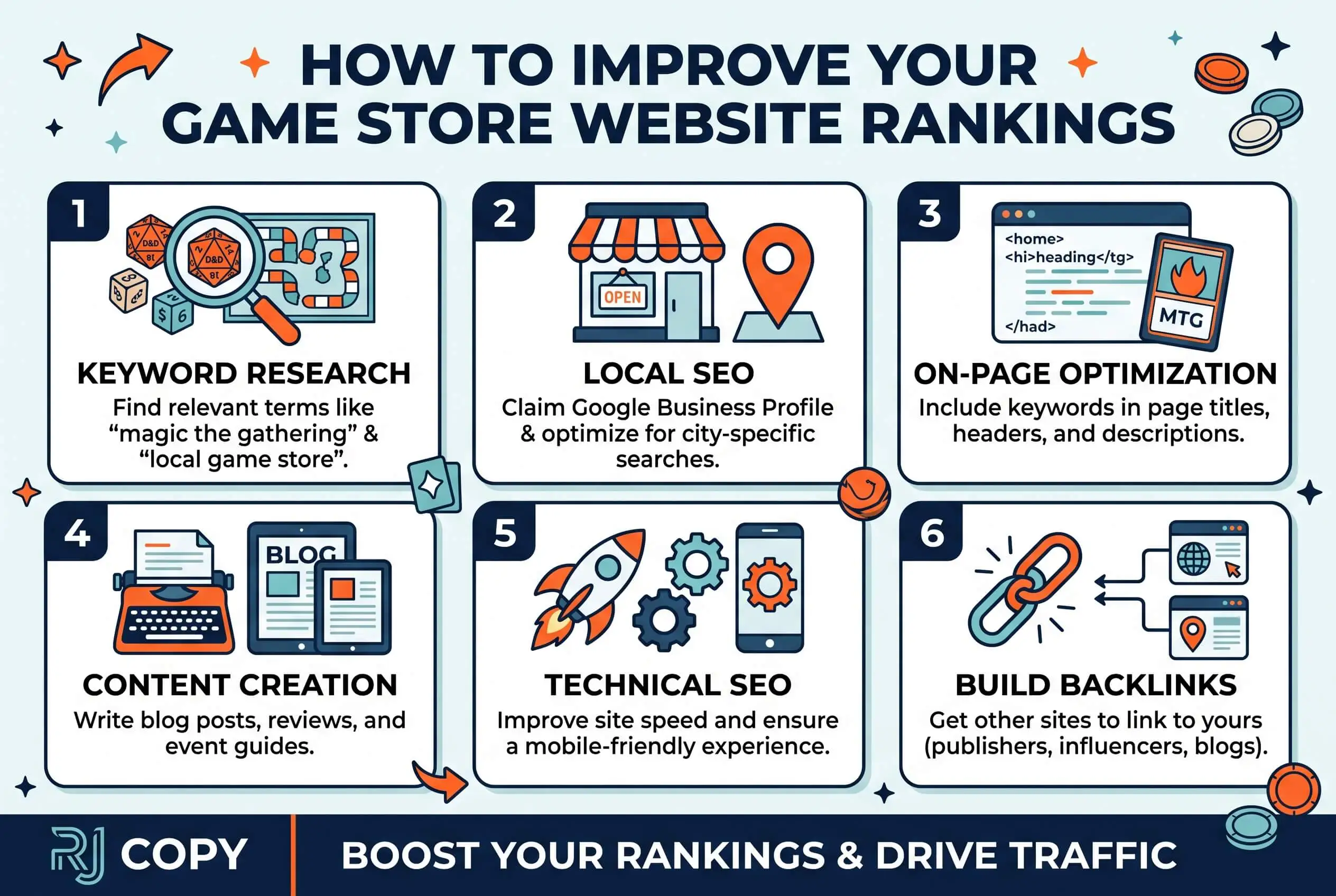
Here’s the order to work through. Five moves, and the first one takes an evening.
TL;DR Quick Answers
Game Store Marketing
Game store marketing is how a friendly local game store (FLGS), hobby shop, or game café gets local players through the door and turns them into regulars. For a physical store it runs on visibility and community rather than discounts, and the highest-return moves cost time instead of money.
What actually moves the needle, roughly in order:
Google Business Profile. The primary category matters most. A game café filed only as a café won't surface for game store searches.
A page for each recurring event. "Where to play Commander in [your city]" is a search no big-box retailer is chasing.
Hobby-specific listings. Wizards Play Network, Play! Pokémon, Games Workshop, TCGplayer, with your name, address, and phone matching across all of them.
Reviews, steadily. Recency and a reply to each one beat twenty in a burst.
Email tied to your event calendar. One short note fills a table on a slow Tuesday.
The throughline: you win on the room, not the price tag. Rankings get somebody through the door once. Events and email bring them back.
Top Takeaways
Your Google Business Profile primary category is the highest-value thing you control. A game café filed only as a café will never rank for game store searches.
Every recurring event deserves its own page. “Where to play Commander in [your city]” is a search no big-box retailer is chasing.
Hobby-specific listings beat generic directories. The Wizards, Pokémon, Games Workshop, and TCGplayer locators send you people who’ve already decided to play.
Answer the beginner question in writing. “Can I come if I’ve never played?” is high-intent, high-volume, and almost entirely unanswered.
Reviews reward habit over campaigns. A steady trickle, plus a reply to each one, beats twenty in a burst.
Rankings get them in once. Game store marketing gets them back. Ranking with no email, events, or positioning behind it just produces well-informed strangers.
Why Local Players Can’t Find You
Three things usually go wrong. Most stores have two of them running at once.
You’re missing from the map pack. An unclaimed or half-finished Google Business Profile keeps you out of the three local results that sit above everything else on the page. Nobody scrolls past those. They tap one, glance at the photos, and start driving.
Your website is one page long. A single “Shop” page ranks for roughly one thing. Every game line on your shelves, every event on your calendar, every question you field at the counter: each one is a search you’ve quietly conceded.
Your site hasn’t changed since 2019. Google reads a frozen website as a shrug. It can’t tell whether you’re still open, still running Commander night, or still worth showing to anyone.
None of this is exotic. It’s ordinary marketing work aimed at a search engine instead of a shop window, and stubbornness beats budget nearly every time.
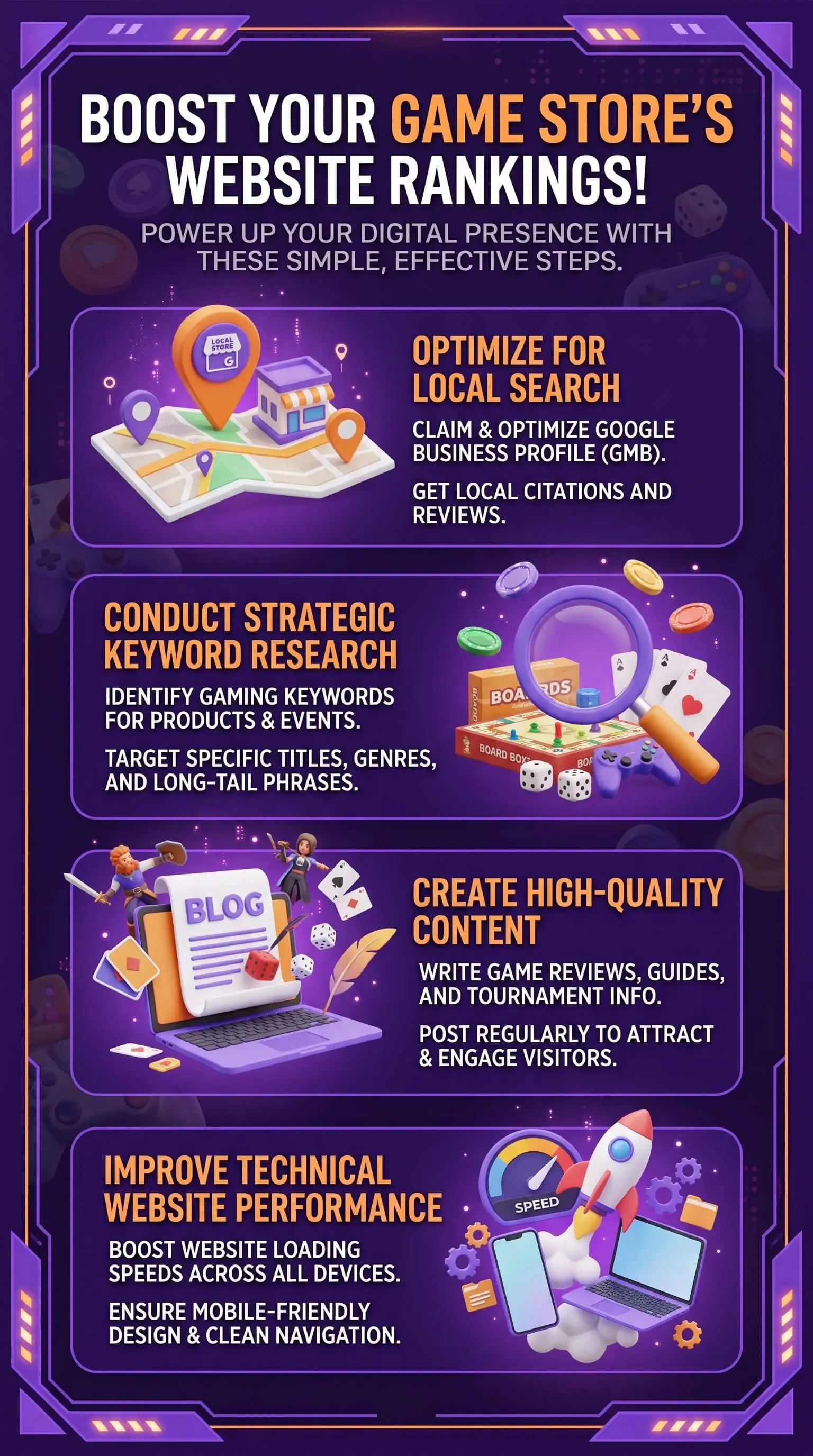
Fix Your Google Business Profile First
An hour of work, nothing spent, and it outperforms everything else on this page. It’s also the job most stores start and never finish.
Claim the listing, then verify it. If you’ve never logged in, somebody else may have edited your hours. Go and look.
Set your primary category to Game store, then add accurate secondary ones. File a game café as a café and it won’t surface for game store searches, however many games sit on the shelves. This is the most common unforced error in the hobby.
Get your hours right, event nights included. If Commander runs till eleven on Thursdays, put that in. Google favors businesses that are open at the moment somebody searches, so trimming your hours costs you your busiest window.
Upload real photos of a full table. Not stock art. Not an empty storefront at 8am. The room is the product.
Fill in Products and Services with what you genuinely stock and genuinely do.
Seed the Q&A yourself, using the questions you answer out loud every week. Do you have open tables? Can I play without buying anything? Is there parking?
While you’re in there, skip the folklore. Geo-tagging photos does nothing at all. Stuffing keywords into your business description does nothing good, and it can get the profile suspended outright.
Turn Your Event Calendar Into Ranking Pages
Here’s the move almost nobody makes, and it’s where a game store holds ground no big-box retailer can take.
A recurring event is a location-locked, high-intent search with almost no competitor. Nobody at Amazon wants to rank for where to play Commander in Boise. That phrase sits unclaimed, and you run the only business in town that can answer it honestly.
So get your calendar out of that Facebook image. Out of the PDF, too. Search engines read neither one.
One indexable page per recurring event. Not one page listing all of them. One each.
Put the game, the event type, and your city in the heading. “Friday Night Magic in [Your City]” outperforms “Events” every time.
Answer the beginner question on every page. “Can I come if I’ve never played?” pulls real search volume, and almost no store answers it in writing. Answer it and you collect the traffic and the nervous first-timer together.
Say what to bring, what it costs, when it starts, and what happens if you turn up alone. That last detail converts better than any discount you could run.
Post a recap afterward. Ten minutes and a phone photo, and your site reads as alive to Google and to whoever’s deciding whether to walk in.
Get Listed Where Players Are Already Looking
Generic directories do almost nothing for a game store. Hobby-specific ones do a great deal, because everybody searching them has already committed to playing something. They’re only picking a room.
Work through whichever ones match what you actually sell. The Wizards Play Network and its public store locator. The Play! Pokémon retail program. Your Games Workshop stockist listing, your TCGplayer store profile. Then the local Discords and subreddits, which aren’t SEO at all but are exactly where a new player asks the question out loud.
Two things matter here. These listings send you people, not just ranking signals. And your name, address, and phone number have to match your Google Business Profile character for character on every single one. Mismatched details quietly strangle your visibility, and fixing them is the dullest hour you’ll ever spend well.
Indie creators hit the same wall from the other side of the shelf. The marketing strategies that work for small tabletop publishers rest on the same unglamorous groundwork.
The Technical Bits That Actually Matter
Short section, because most of what gets sold as technical SEO is noise.
Make the site fast on a phone. Your visitor is sitting in a parked car deciding whether to come in. Slow loses them before the homepage finishes loading.
Add LocalBusiness structured data so Google reads your address, hours, and phone as facts instead of guessing at them.
Add Event structured data to your event pages. Be clear-eyed about what this buys. Schema isn’t a strong ranking factor, whatever the person selling it tells you. It makes your Friday night eligible to appear in Google’s event experiences, and that’s the whole benefit. Skip it and you’re not in the queue.
Treat reviews as a habit, not a campaign. A steady trickle with recent dates beats twenty in one week, which looks exactly as suspicious as it is. Ask at the register after a good event. Reply to all of them, unkind ones included, briefly and without arguing.
Holding all of it consistent is the actual work. Same principle behind any effective retail brand management.
Where Game Store Marketing Fits In
Now the honest limit, because pages like this one usually skip past it.
Everything above gets somebody through your door once. None of it brings them back. Rankings are one pillar of a wider practice covering positioning, board game copywriting services, email, events, and social, and on their own they underperform badly. A first-timer who finds you on Google and then hears nothing from you again becomes a one-time visitor with a nice story about your shop.
The rest of that picture lives in the wider game store marketing playbook, which covers the branding, email, and community work that turns a found customer into a regular.
“After five-plus years writing for tabletop clients, the pattern I keep hitting is that the store itself is almost never the problem. The community’s already there. Nobody’s written it down anywhere a search engine can reach. I’ve lost count of the shops running four packed events a week whose whole calendar lives inside a Facebook image, which as far as Google is concerned is a blank wall. The priciest mistake is smaller still: a game café filed on Google as a café. One dropdown, chosen once, quietly deciding you’ll never turn up for the search that matters most. Fix the boring things first. You’ve already earned the community piece.”
7 Essential Resources
Seven links worth bookmarking before your next marketing afternoon. All free, and all the primary source rather than somebody’s summary of it.
1. Claim Your Google Business Profile
Google’s own walkthrough for claiming and verifying a listing, which governs how you appear in Maps and the local results. If you do one thing off this page, make it this.
Source: Google Search Central: Add Business Details to Google
2. Join The Wizards Play Network
The official sanctioning programme for Magic and D&D organised play. Enrolling drops your store and your calendar into the public locator players use to find a table.
Source: Wizards Play Network · public-facing Wizards Store & Event Locator
3. Become A Play! Pokémon Store
The retail programme for Pokémon organised play. Approved stores get prize support, exclusive product, and a place in the official Event Locator. That last one is a free, high-intent listing most shops never bother to claim.
Source: Pokémon: Run a Play! Pokémon Store & Host Events
4. Mark Up Your Events So Google Can Read Them
The official spec for Event structured data, and what makes your weekly game night eligible for Google’s event surfaces instead of invisible to them.
Source: Google Search Central: Event Schema Markup
5. Mark Up The Store Itself
The LocalBusiness structured data guide. Hours, address, departments, phone, all handed to Google as data instead of left for it to infer.
Source: Google Search Central: Local Business Structured Data
6. Check Your Markup Before You Trust It
Paste in a URL and Google tells you which rich results the page actually qualifies for. Broken schema is common and completely invisible without a test like this.
Source: Google Rich Results Test
7. See What Actually Moves Local Rankings
Forty-seven local search experts score 187 ranking factors, published free every couple of years. Read it for the myths section alone, which spares you a lot of bad advice.
Source: Whitespark: Local Search Ranking Factors 2026
Supporting Statistics
Three numbers worth holding onto before your next marketing decision. Each comes from the organisation that produced the research, not an aggregator repeating it.
1. Your Google Category Outranks Nearly Everything Else You Could Fix
Whitespark’s 2026 Local Search Ranking Factors survey asked 47 local search experts to score 187 factors. Primary Google Business Profile category placed first for local pack and Maps rankings, ahead of how close you are to the searcher. A dedicated page for each service placed first for local organic results. Translated for a game store: fix the category, then build a page per event.
Source: Whitespark: Local Search Ranking Factors 2026 (Darren Shaw, published November 2025)
2. Nearly Half Of Consumers Now Ask An AI Tool Where To Go
BrightLocal’s Local Consumer Review Survey 2026 polled a representative panel of 1,002 US adults. The share using AI tools like ChatGPT and Google’s AI Mode to find local businesses climbed from 6% to 45% inside a year, while Google’s own share of local discovery fell from 83% to 71%. Clear, well-structured, factual pages are how you get recommended now, not just how you rank.
Source: BrightLocal: Local Consumer Review Survey 2026
3. Demand Isn’t Your Problem
ICv2 puts the hobby games market at roughly 40% growth to $3.66 billion in 2025, counting it as the seventeenth straight year of growth in the hobby channel. That happened in a year with tariffs and a distributor bankruptcy in it. More players live within driving distance of your counter than ever have. Whether they can find you is the only bottleneck.
Source: ICv2: Big Growth in Hobby Games in 2025
Final Thoughts & Opinion
Here’s the position worth taking: a game store wins by being a place, not a price. Most game store marketing advice gets that backwards and opens with promotion. Local SEO is only the paperwork of being a place. Dull, free, almost always undone.
A few honest observations.
The problem is translation, not effort. Owners already do the hard part. Running events, teaching rules, remembering names. They just never wrote any of it down where a search engine could find it.
Two fixes carry most of the upside. A finished Google Business Profile with the right primary category, and one real page for your biggest weekly event. Do those two, skip the rest, and you’ll still sit ahead of most of your competition.
Be suspicious of anyone selling speed. Profile changes can move inside a week. Organic rankings take months. A consultant promising page one by Friday is describing something that doesn’t exist.
The stores that struggle most cast themselves as the hero. You’re not the hero. Your players are, and the job is to be findable, then hand them the right game and the right table.
If that reads like a lot to juggle between running events and counting the till, it is. But the first three moves are genuinely a weekend’s work, and nobody needs hiring for them. If you later want to scale faster, partnering with a multicultural marketing agency can help expand your reach without taking your focus away from the day-to-day running of your business.
Frequently Asked Questions
Q: How Long Until A Game Store Website Ranks?
Google Business Profile changes can show inside days, sometimes hours. Website rankings usually need a few months to climb, then keep improving. Run both at once. The profile work gives you quick wins while the pages play the long game. Anybody promising fast organic results is describing something that doesn’t happen.
Q: Do I Need A Website If I Already Have A Google Business Profile?
Yes, because they do different jobs. Your profile puts you in Maps and the local pack, so that’s where people find you. Your website ranks for everything the profile can’t hold: individual events, game lines, the beginner questions. Treat the profile as the front door and the website as the store.
Q: What’s The Single Most Important Local SEO Fix For A Game Store?
The primary category on your Google Business Profile. In Whitespark’s 2026 survey of local search experts it scored higher than any other local pack factor, including how close you are to the searcher. Checking takes thirty seconds, and it’s wrong more often than you’d expect.
Q: How Much Does Game Store Marketing Cost?
The highest-return moves cost time rather than money. Claiming the profile, fixing the category, building an event page, asking for reviews: all free. Paid help earns its place once the free work is done and the bottleneck turns into strategy or writing instead of effort. Get a number in writing before committing to anything.
Q: Can I Do This Myself, Or Should I Hire Someone?
Most of this page is genuinely do-it-yourself. The profile, the categories, the listings, the review habit: no specialist needed, and you’ll do it better than an agency would because you know your regulars. Outside help earns its fee on the parts that take judgement and writing. Positioning, the words on the page, and a plan that turns a first visit into a tenth one.
Let’s Get Your Store Found
Remember the person who moved to town and drove two towns over? They’re still hunting for somewhere to play. So is everybody else who arrived this year.
Start with the five moves above, one a week, in order. Claim the profile. Fix the category. Build the page for your biggest event. Claim two locators. Ask five regulars for a review. That’s a month of small evenings, and it puts you ahead of nearly every shop still hoping word of mouth does the whole job.
And if you’d rather hand the writing to somebody who already speaks the language, that’s what game store marketing help is for. Your shop is already the best room in town. Let’s make sure the right people can find it.