How many of last month's visitors actually bought something? If the answer stings, look at search before you spend another dollar on ads.
We see the same pattern with growing online stores. Shoppers land on blog posts and thin category pages while the product they wanted sits on page three of Google. A Black owned SEO company that specializes in e-commerce can step in as your partner and fix that where the money is: your product pages, your category pages and the structure that ties them together.
Ownership adds something a generic agency can't fake. A firm that is Black or African American owned brings a team that understands how diverse shoppers search, what they call things and who they decide to trust. If your store sells to a multicultural audience, you'll see that insight in your sales report.
TL;DR Quick Answers
Black Owned SEO Company
A black owned SEO company is a search marketing firm at least majority owned by Black or African American entrepreneurs that helps businesses rank higher on Google and turn that traffic into customers. For online stores, the best ones pair technical e-commerce SEO with a real read on how diverse shoppers search and buy.
What they do: keyword research, product and category page optimization, structured data, technical fixes and link building.
What ownership adds: cultural fluency in the language, imagery and trust signals your customers respond to.
Extra business value: a certified Black-owned vendor can count toward supplier diversity goals.
How to choose one: confirm certification, ask for online store results and require reporting on revenue, not rankings alone.
Full-service option: agencies like The Sax Agency in Los Angeles run search, web development and brand strategy under one umbrella, with packages tailored to your budget.
Top Takeaways
E-commerce SEO lives and dies on product pages, category pages and technical health.
A Black owned SEO company brings cultural fluency that shapes your keywords, copy and trust signals.
Ask for a minority business certificate before you sign anything.
Judge every firm on organic revenue and conversions, since rankings alone don't pay the bills.
If search, site and brand all need work, one full-service team will usually move faster than several specialists.
What Black Owned SEO Firms Bring to E-Commerce
Why Ownership Matters for Your Online Store
Search starts with language, and language is cultural. The words a shopper types, the photo that earns the click and the review that tips someone from browsing to buying all carry context. A Black owned SEO firm brings that context into keyword research and page copy from day one. Your store ends up talking with your customers instead of at them.
There's a practical upside as well. Plenty of brands track supplier diversity goals, and a certified Black-owned vendor counts toward them. For the bigger picture, here's how Black-owned digital marketing agencies work across channels beyond search.
Some stores need search, site and brand moving at the same pace. That's when a full-service partner earns its keep. The Sax Agency, a black owned SEO company and marketing agency in Los Angeles, can step in and run search marketing, web development, social media and brand strategy under one umbrella. You get one team that owns the plan, so nobody passes your store back and forth between vendors when sales stall. Flexibility matters here too. Sax tailors packages to your budget and goals, or takes on a single project if that's all you need.
What E-Commerce SEO Covers That General SEO Misses
A service business might have a few dozen pages worth ranking. An online store can have thousands, and every one of them competes for a spot in search, which is why e-commerce needs its own playbook.
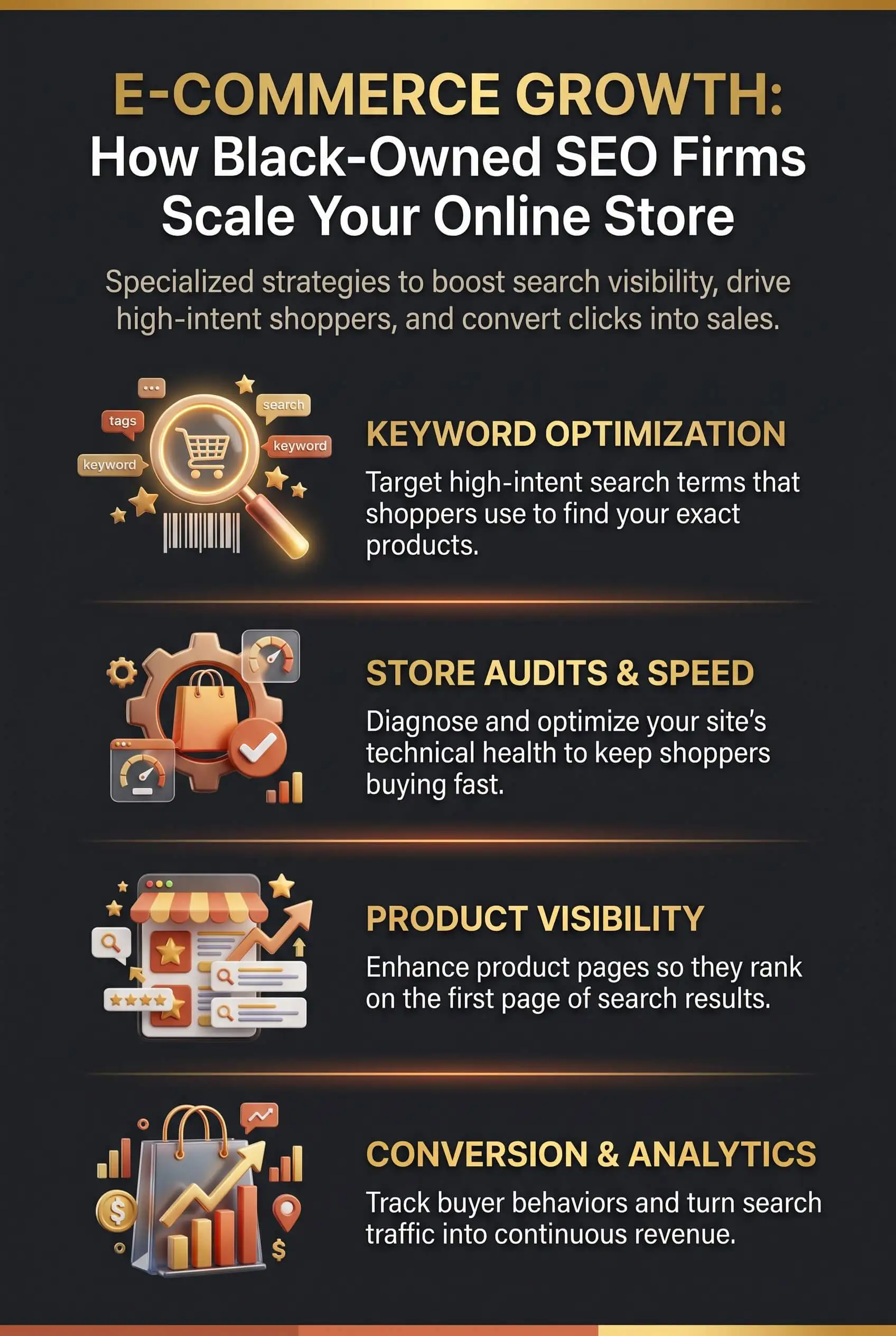
Product pages: original descriptions in place of manufacturer copy, Product structured data so Google can show price and stock, descriptive image alt text and visible reviews.
Category pages: a short intro written for the buying search, plus internal links that pass authority down to products. These pages often rank for the broadest terms in your niche.
Technical health: filter and sort URLs that don't flood Google with near-duplicates, product variants that consolidate rather than compete, and mobile pages that load fast. Smaller shops face the same fundamentals, as this look at ranking a niche online store shows.
Brand consistency: product names, claims and imagery that match across your site, marketplaces and Google listings. Our piece on retail brand consistency explains why that builds trust.
How to Evaluate Black Owned SEO Firms
We've sat through plenty of agency pitches. The slickest deck in the room rarely predicts results, so run every firm through this checklist and notice which questions they dodge.
Verified ownership: Ask whether the firm is certified as minority or Black owned, and by whom. Red flag: vague answers or no paperwork.
E-commerce experience: Ask which online stores they've grown and on which platforms. Red flag: a portfolio of only service businesses or local SEO.
Technical audit process: Ask how they find indexing, speed and duplicate-page problems. Red flag: a proposal with no audit behind it.
Revenue reporting: Ask whether they report organic revenue and conversions. Red flag: reports that stop at traffic and keyword positions.
Content practices: Ask who writes product and category copy and who edits it. Red flag: bulk AI copy nobody reviews.
Link building: Ask how they earn links and request examples. Red flag: guaranteed link counts or private networks.
Contract terms: Ask about the minimum term and what you keep if you part ways. Red flag: long lock-ins or an agency that owns your content.
To check ownership of a top branding agency, ask for a minority business certificate. The National Minority Supplier Development Council runs one of the most widely recognized programs, and a firm that holds one will usually mention it before you ask.
"Here's the pattern we keep running into. A store owner celebrates hitting page one, and three months later revenue hasn't budged. When we look under the hood, the traffic is landing on blog posts and thin category pages while the products people came to stay buried. Our fix almost always starts with the catalog. We rewrite the product pages for the best sellers first, then change the monthly report so it leads with orders. Ownership gives you insight into the audience, and discipline is what turns that insight into sales."
7 Essential Resources
We keep these open whenever we plan e-commerce SEO or vet a new partner. All seven are free to read.
Best practices for ecommerce sites in Google Search: Google's own guidance on product data, URLs, navigation and pagination for online stores. Read it before you brief any agency.
Merchant listing (Product, Offer) structured data: the markup that lets Google show your price, stock and shipping right in the results.
U.S. Census Bureau Quarterly Retail E-Commerce Sales: the official read on how fast online retail is growing, updated every quarter.
Measuring Black Enterprise, U.S. Census Bureau: current counts of Black-owned employer firms, the people they employ and their payroll.
Black employers are reaching new heights, Brookings: where Black-owned employer businesses are growing, by city and by industry.
NMSDC Certification Process: how minority business certification works, handy when you're confirming a firm's ownership.
Minority Business Development Agency: the federal agency that connects minority-owned firms with capital, contracts and new markets.
These seven essential resources provide valuable guidance for e-commerce businesses looking to improve their SEO and choose the right brand agency. From Google's best practices for product listings and structured data to insights on Black-owned businesses and minority business certification, these resources help online stores strengthen search visibility, verify agency credibility, and build effective strategies for long-term growth.
3 Statistics
$340.2 billion in U.S. online retail sales in a single quarter. The Census Bureau puts second-quarter 2026 retail e-commerce at $340.2 billion, up 12.2% from a year earlier. Total retail grew 6.7% over the same stretch, so online sales are growing almost twice as fast. Source: U.S. Census Bureau
17.1% of U.S. retail now happens online. That's the seasonally adjusted share for Q2 2026, up from 16.3% a year before. Every point of share represents shoppers who found what they bought through a screen, and often through a search. Source: Federal Reserve Bank of St. Louis (FRED), Census data
About 200,900 Black-owned employer firms in the U.S. The Census Bureau's Annual Business Survey counted them in 2023. Together they employed 1.9 million people and paid $69.8 billion in annual payroll. For brands that want a partner with a shared perspective, the pool of Black-owned firms keeps getting deeper. Source: U.S. Census Bureau, Annual Business Survey
Final Thoughts and Opinion
Our take: hire the firm that asks about your margins and best sellers before it says a word about keywords. Ownership gives a Black owned SEO firm a head start on understanding your buyers. Push hardest in the pitch on the catalog, the page templates and the technical setup, because that's where most e-commerce SEO either wins or stalls.
For growing stores, we lean toward full-service partners. When one team handles search, the site and the brand, a fix doesn't sit in limbo waiting on a handoff between vendors, and that speed adds up over a year. For a wider view of the field, our roundup of Black owned digital marketing agencies covers firms across more disciplines.
Frequently Asked Questions
What does a Black owned SEO company do for e-commerce brands?
It improves how your products and categories show up in search. The work covers keyword research, product and category copy, structured data, technical fixes like page speed and duplicate URLs, and link building. A Black-owned firm also brings insight into how diverse shoppers search and what earns their trust.
How do I confirm an SEO firm is Black owned?
Ask to see its certification. The National Minority Supplier Development Council certifies businesses that are at least 51% minority owned, operated and controlled [VERIFY], and many cities and states run their own programs. A firm with nothing to hide will share its certificate the same day you ask.
How long does e-commerce SEO take to show results?
Most stores see early movement within three to six months. Bigger revenue gains usually build over six to twelve. Technical fixes can pay off quickly, while new content and links take longer to earn their place. Your catalog size, your competition and how fast changes go live all shift the timeline.
Should I hire an e-commerce specialist or a full-service agency?
If you already have people running your site and brand, a specialist can slot in nicely. If you don't, a full-service agency usually makes more sense, because someone has to build what the SEO plan recommends. Ask yourself who will make the changes, and how quickly. That answer tends to settle it.
What should an e-commerce SEO report include?
Look for organic revenue, conversion rate, orders and traffic to product and category pages. A good report also lists the technical issues fixed, the pages improved and what's planned next. Rankings can appear in it, but if they're the headline every month, push back.
Ready to Turn Search Traffic Into Sales?
Your store deserves a partner who knows your customers as well as your catalog. The Sax Agency starts with an audit of where your traffic goes today, then builds a plan around your budget and goals, whether that's a single project or a full package. Connect with The Sax Agency in Los Angeles to talk through where search fits in your growth plan.


