That's the side of brand marketing for therapists most clinicians never get to see. Picking a therapy practice is about as personal as decisions get, so the trust that gets someone to book forms long before your first conversation. It forms on your homepage, in your directory profile, and in the two lines Google shows under your name.
I've written about enough healthcare and mental health practices to notice something uncomfortable. The therapists who get passed over usually aren't the less skilled ones. Their websites just don't show the care they bring into the room.
So let's sit on the other side of the screen for a while.
TL;DR Quick Answers
Brand Marketing For Therapists
Brand marketing for therapists is how a private practice earns a new client's trust before the first session. It puts who you help, how you work, and what therapy with you costs and feels like onto your website, directory profiles, and search listing, in plain words that stay inside your ethics code.
Name a person, not a diagnosis: "new parents who feel like strangers to each other" lands harder than "individuals, couples, and families."
Write in your client's words: "can't stop worrying at 2 a.m." reaches more people than "generalized anxiety."
Make trust easy to check: your license and state, a current photo, visible fees, and a short "what to expect" section.
Show care people can see: secure intake forms, honest reply times, and one consistent voice on every profile.
Keep it ethical: no promised outcomes and no solicited client testimonials.
The care already shows up in your sessions. A strong board game crowdfunding strategy, supported by good brand marketing, makes it visible to a stranger reading on a phone at midnight.
Top Takeaways
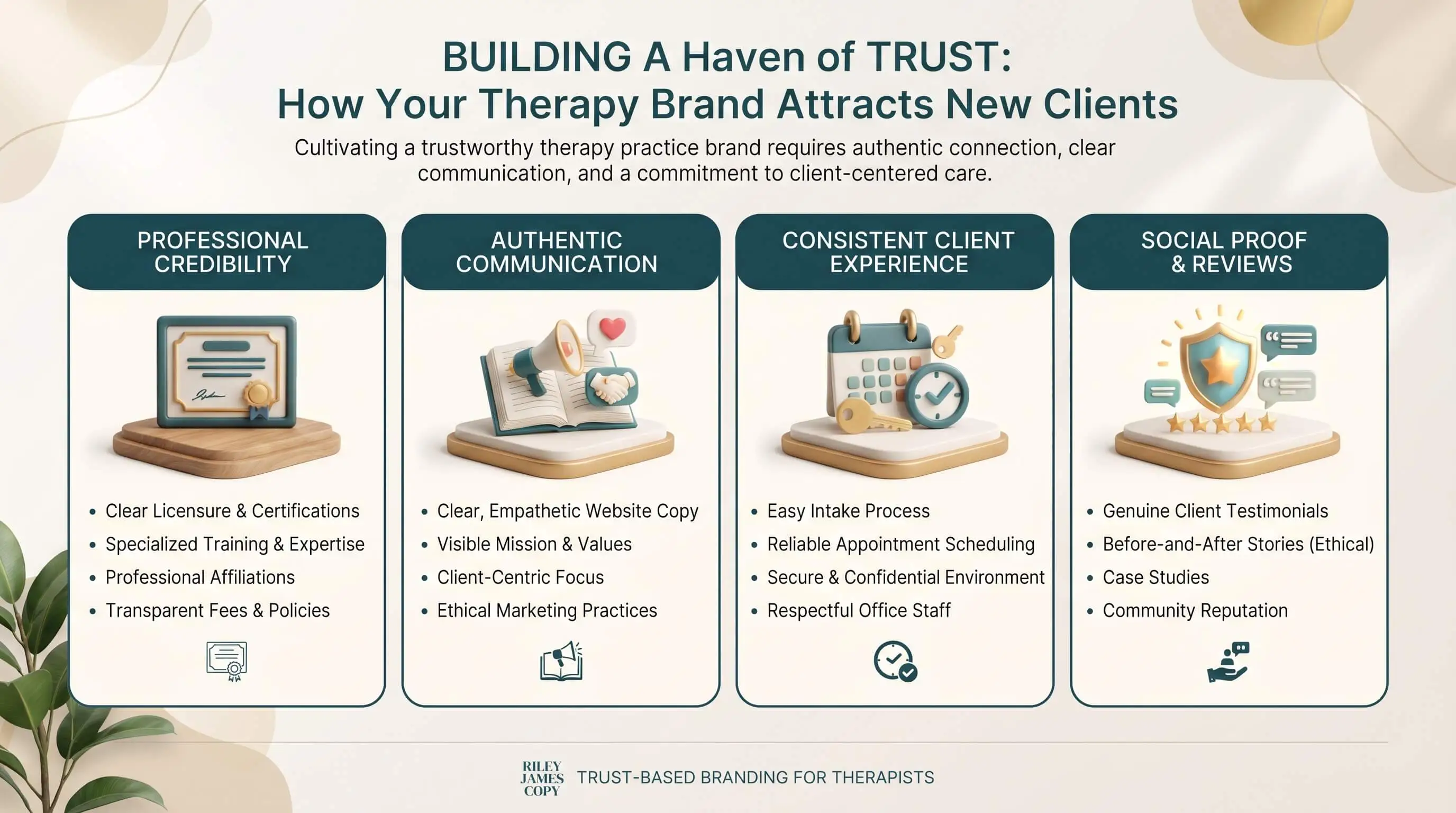
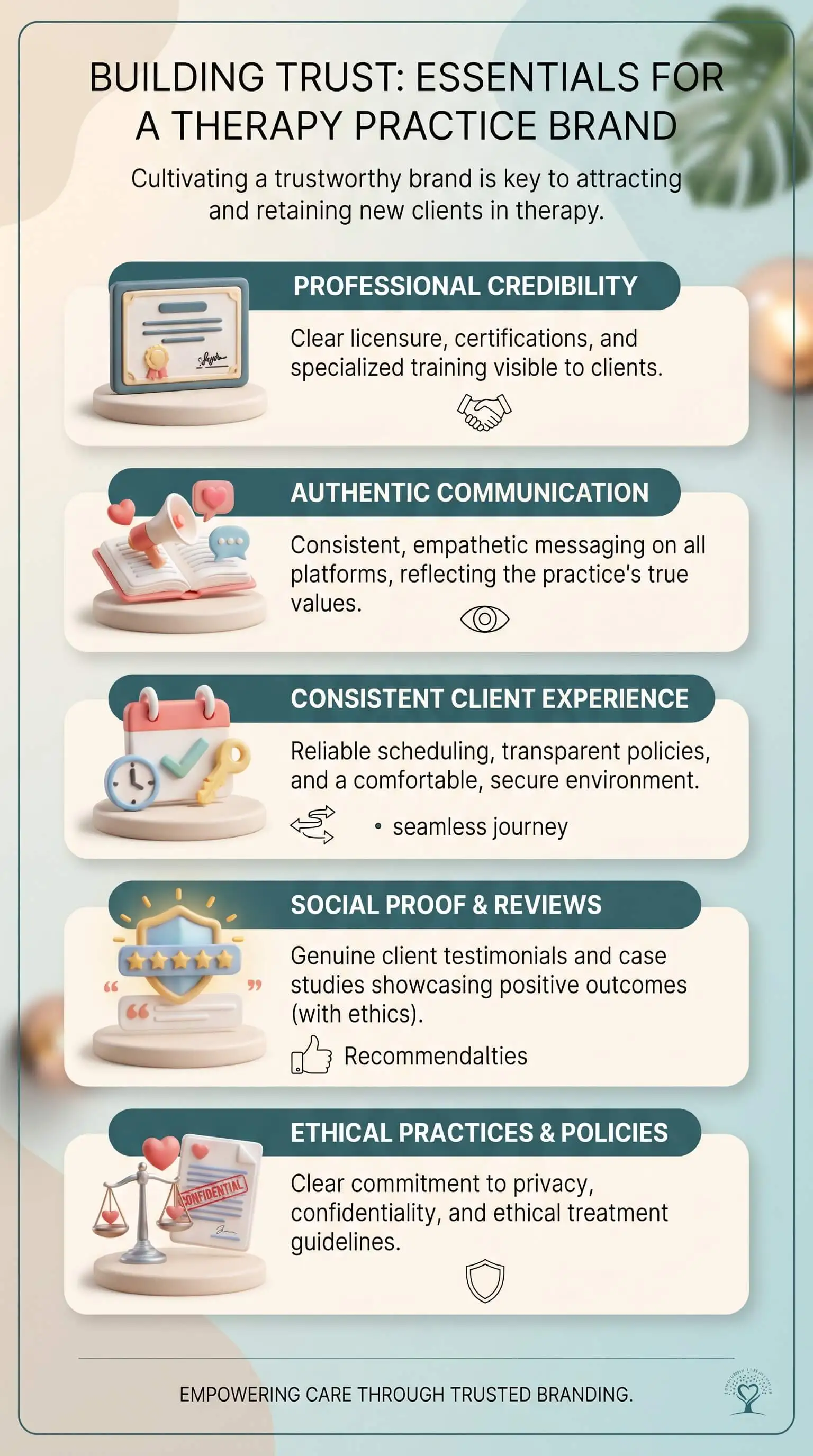
New clients decide whether to trust a therapy practice before they call, usually from its website and the profiles around it.
A niche that names a person and a moment lets the right client recognize themselves on the first read.
Verifiable credentials, visible fees, and a short "what to expect" section clear away the uncertainty that stops people from booking.
Privacy you can see and honest reply times tell clients they'll be handled with care.
A therapy practice brand should sound like the same person on every page and profile, because mismatches make nervous readers more nervous.
Why New Clients Decide Before They Ever Call
A prospective client has usually made up their mind about your practice before they ever hear your voice. They can't sit in on a session first, so they read for clues.
Those clues carry more weight than most therapists expect. Plenty of people reaching out are worn down or caught in the kind of constant overthinking that turns every small choice into a big one. Openings are tight across the field, too, so people often message several practices at once and go with whoever feels clearest and safest.
Looks count more than anyone likes to admit. Stanford's long-running web credibility research found that people judge a website's believability by its design more than by anything else on the page, including what it actually says.
The Trust Signals New Clients Look For
Call it the new client trust checklist. Nothing on it needs a big budget, only the willingness to look at your practice the way a nervous stranger would.
A Niche That Names A Person
Clients trust a practice that seems to understand their exact situation. A line like "I work with individuals, couples, families, and teens" is accurate, but it tells a hurting reader nothing about whether you get them.
Now try "I help new parents who feel like strangers to each other since the baby came." The right person recognizes themselves before they finish the sentence. That moment of recognition is where good brand marketing for therapists starts, and it costs you nothing except some clarity about who you do your best work with.
If your homepage's first sentence doesn't name a person and a moment, that's the first thing I'd rewrite.
Words That Sound Like Your Client, Not Your License
People trust the therapist who describes their problem the way they would. Clinical terms are precise. To someone having the worst month of their year, they also read like a chart note.
Here's an illustrative before and after:
Before: "Evidence-based treatment for generalized anxiety disorder."
After: "For when your mind won't stop running worst-case scenarios at 2 a.m."
Both describe the same service, but only the second sounds like it came from someone who listened. Keep a running list of the phrases clients use on first calls, then borrow them shamelessly.
Credentials They Can Verify
Credentials earn trust when a client can understand them and check them. The letters after your name mean a great deal to colleagues and very little to someone who has never been in therapy.
Spell out your license type, the state that issued it, and where someone can look it up. Then give your training a reason. "I trained in EMDR because trauma kept showing up in my work" tells a client more about you than six modalities in a row ever will.
A Real Face And A Human Bio
A current, natural photo of you is one of the fastest trust signals a therapy site has. Stock photos of smiling strangers work against you, because people want to know who will actually be sitting across from them.
Your bio should open with the client rather than your résumé (your licensing board already has that). Lead with who you help and how you work. Credentials can follow, with a small human detail at the end if it suits you.
Clear Fees, Insurance, And Estimates
When clients can't find your rate, they usually assume it's out of reach and leave without asking. Hidden costs read as hidden motives, even when that's the last thing you meant.
Show your fee or a range, say whether you're in-network or out-of-network, and mention a sliding scale if you offer one. If you see self-pay clients, the No Surprises Act generally requires a good faith estimate of expected charges, so add a plain note about it to your fees page. Aim for fees that sit one click from the homepage.
A Clear Picture Of The First Session
Uncertainty is often the last thing standing between a client and the booking button. A short "what to expect" section lowers that bar more than any headline you'll ever write.
Walk them through it in five or six calm sentences. Cover how to book, how long the first session runs, what you'll talk about, whether it's online or in person, and what happens if they need to cancel.
Privacy They Can See
Clients trust a practice that visibly protects their information. Think secure intake forms, a privacy note in everyday language, and a clear line about how and when you'll contact them.
The quieter risk lives in your site's code. HHS has warned health providers that ad pixels and analytics tools can expose health information, so ask whoever runs your website which trackers load on your contact and booking pages. It's a ten-minute conversation, and it's worth having.
Honest Availability And Reply Times
Telling clients the truth about your openings earns more trust than looking busy or looking wide open. If you keep a waitlist, say so. If you reply within two business days, put that next to the contact form.
People who know what to expect will often wait. People who hear nothing for a week assume the worst and move on to the next tab.
One Consistent Brand Everywhere They Look
Clients check more than one place, and mismatches make them uneasy. Your website, Psychology Today profile, Google Business Profile, and intake emails should all sound like the same person wrote them.
That's the job of a consistent brand voice. A directory listing promising "evidence-based solutions" beside a gentle, plain-spoken website feels like two different therapists. I'd read the two side by side once a quarter and smooth out whatever doesn't match.
A Site That Looks Cared For And Works On A Phone
A tidy, readable website tells clients you'll take care with them, too. Most of them will find you on a phone, and plenty will do it late at night.
Readable types and buttons that actually work go a long way. Broken forms and a footer that still says 2021 send a small signal of neglect that clients notice more than you'd think. A freelance healthcare content writer can help make the content clear, but this week, fill out your own contact form from your phone and see what they see.
What Quietly Breaks Trust
A handful of habits can undo good work faster than the checklist above builds it:
Promised outcomes. "You'll feel better in six sessions" is a promise nobody can keep, and many ethics codes warn against it.
Solicited client testimonials. The APA code bars psychologists from soliciting them from current therapy clients, and counselors, social workers, and MFTs have their own versions of that rule.
Stock-photo smiles that obviously aren't you or your office.
Walls of jargon that make a hurting reader feel like a case file.
Fees a client has to email you to find out.
A contact form that never writes back.
How To Audit Your Practice Brand In One Afternoon
Block off two or three hours and work through these in order:
Read your homepage as a stranger would at midnight. Does the first sentence say who you help?
Circle every clinical term, then ask whether a client would ever say it out loud.
Open your directory profile beside your homepage and fix anything that doesn't match.
Check that your fees, insurance status, and good faith estimate note are easy to find.
Submit your own contact form from your phone and time the reply.
Cut any claim you wouldn't feel comfortable defending to your licensing board.
"Before I ever wrote a copy, I spent ten years in ministry, and most of the hard conversations started with a stranger quietly deciding whether I was safe to talk to. I watch that same decision happen on therapy websites now. The practices that earn the call are rarely the loudest ones. They sound like they've already been listening."
Essential Resources
Before you rewrite a single page, here's where I'd send you. I've ordered them from how clients pick a therapist to the privacy and pricing rules that keep their trust once you have it.
1. See Your Practice Through A New Client's Checklist
The APA's public guide walks people through choosing a psychologist, right down to the questions they should ask before booking. Read it the way a future client would, then make sure your website answers those questions first.
Source: American Psychological Association: How to Choose a Psychologist
2. Know What "A Good Fit" Means To Them
This APA guideline page tells people to look for a therapist they feel comfortable with and to take their time finding one. Your brand's whole job is helping them sense that fit before they ever meet you.
Source: American Psychological Association: Finding a Good Therapist
3. Use The Research Behind Website Credibility
Stanford's Persuasive Technology Lab boiled years of research with more than 4,500 participants down to ten guidelines for a credible website. Nearly every one of them applies to a therapy homepage.
Source: Stanford Persuasive Technology Lab: Stanford Guidelines for Web Credibility
4. Write Pages Search Engines Trust Too
Google's guidance on helpful, people-first content reads a lot like advice for writing to one anxious reader. Pages that pass its self-check tend to win over people and search engines alike.
Source: Google Search Central: Creating Helpful, Reliable, People-First Content
5. Keep Trackers Off Your Intake Path
HHS explains how pixels and analytics tools can expose health information on provider websites. A 2024 court ruling narrowed part of this guidance, so treat it as a careful starting point and bring your web provider into the conversation.
6. Make Self-Pay Pricing Easy To Find
CMS lays out the No Surprises Act, including the good faith estimate providers generally owe uninsured and self-pay clients. Clear pricing happens to be a legal duty and a trust signal at the same time.
Source: Centers for Medicare & Medicaid Services: No Surprises Act Rules and Fact Sheets
7. Make Every Page Readable For Everyone
The W3C's writing tips cover clear headings, plain language, and spelled-out abbreviations. Tired or struggling readers benefit first, and search engines and AI tools read your page more easily too.
Source: W3C Web Accessibility Initiative: Writing for Web Accessibility
Supporting Statistics
I keep these numbers in mind whenever a therapist asks me why branding matters this much.
1. Clients Are Shopping Around Because Openings Are Scarce
In APA's 2025 Practitioner Pulse Survey, 46% of psychologists had no openings for new patients, and 40% kept a waitlist.
When people can't get in everywhere, they reach out to several practices at once. In my experience, the page that feels clearest wins the call, or at least the client's patience to wait.
Source: American Psychological Association: 2025 Practitioner Pulse Survey
2. Many Practices Work Outside Insurance
In APA's 2024 Practitioner Pulse Survey, 34% of psychologists were not in-network with any form of insurance.
That leaves a lot of clients wondering what therapy will cost them. Clear fees and a visible good faith estimate note answer the worry before it costs you the inquiry.
Source: American Psychological Association: 2024 Practitioner Pulse Survey
3. People Judge Credibility By How A Site Looks
In a Stanford study of 2,684 people, 46.1% of comments about a website's credibility mentioned its design or look, more than any other factor.
The study dates to 2002, so read it as a stubborn human habit rather than a fresh trend. A site that looks cared for still tells clients they'll be cared for.
Source: Stanford Persuasive Technology Lab: Web Credibility Research
With limited therapy openings, varying insurance coverage, and website design influencing trust, a multicultural marketing agency can help therapists build clear, welcoming brands that communicate credibility, address client concerns, and make it easier for people from diverse backgrounds to seek care.
Final Thoughts And Opinion
Here's where I've landed after years of writing for healthcare practices. The therapists I work with rarely lack trustworthiness, but most of them struggle to make it visible to someone who has never met them.
Your clients feel your care about ten minutes into the first session. The hard part is getting that care to show up for a stranger reading on a phone, and that's a writing problem far more often than a design or budget problem. I'd fix the words before I touched the logo, and I'd set clear brand objectives before either one.
Honestly, plenty of practices don't need a full rebrand. A sharper directory profile and a rewritten first sentence on the homepage can bring in more of the right calls by themselves. I'd rather you start there than spend money you don't need to spend.
Frequently Asked Questions
Q: What Is Brand Marketing For Therapists?
A: Brand marketing for therapists is how a practice shows who it helps, how it works, and what working together feels like, then carries that message onto its website, directory listings, search results, and emails. Done well, it earns a client's trust before the first session and stays inside your profession's ethics code.
Q: What Makes A Therapist Website Look Trustworthy?
A: The first sentence names who you help, the language is plain, and the photo is actually you. Credentials, fees, and the first step should all be easy to find. A secure contact form, honest reply times, and a layout that works on a phone round it out.
Q: Can Therapists Use Client Testimonials On Their Website?
A: Usually not the way other businesses do. The APA ethics code bars psychologists from soliciting testimonials from current therapy clients, and counselors, social workers, and MFTs follow their own rules. Specialty clarity, credentials in context, and a calm "what to expect" section can carry that trust instead.
Q: Should Therapists List Their Fees Online?
A: In most cases, yes. A client who can't find your fee tends to assume it's too high and leaves. List your rate or a range, your insurance status, and any sliding scale. If you see self-pay clients, note that a good faith estimate is available.
Q: Do Therapists Need A Professional Photo On Their Website?
A: You don't need a studio shoot. You do need a current photo of you, because people want to see who they'll be talking to. A natural, well-lit picture builds more trust than a polished stock image of someone else.
Q: How Can A Therapy Practice Protect Client Privacy On Its Website?
A: Use a secure intake form, explain your privacy practices in everyday words, and be careful with ad pixels and analytics on booking pages. HHS has published guidance on tracking technologies for health providers, so go over it with whoever manages your site.
Q: How Long Does It Take To Improve A Therapy Practice Brand?
A: The core fixes often take a week or two. Rewriting your homepage opening, matching your directory profile, and adding fees and a "what to expect" section don't take long. Search visibility usually needs a few months to catch up.
Q: Is A Psychology Today Profile Enough To Build Trust?
A: It's a strong start, but most clients also check your website and Google listing. When those don't match in specialty and tone, the mismatch can cost you the call. One consistent brand across all of them beats any single profile.
Ready For A Practice Brand New Clients Trust On The First Read?
You already know how to help someone feel safe in the room. Let's get that feeling onto the page a stranger reads at midnight. Book a free 15-minute call with Riley James Copy, and we'll work out the first thing your brand needs, including practical medical copywriting tips to help communicate your care clearly.